Karsten Obarski and the birth of the soundtracker

Most music technology has an origin story with a famous inventor attached — the Moog synthesizer has Bob Moog, the drum machine has Roger Linn, MIDI has Dave Smith. Trackers, the sample-sequencing software that shaped an entire generation of electronic musicians and the demoscene, have Karsten Obarski — and yet almost nobody knows his name. In December 1987, a 22-year-old German developer working for a small games company released a program called Ultimate Soundtracker for the Commodore Amiga. It was buggy, it sold poorly, and its author was so undercompensated for it that within a year, pirated and reverse-engineered versions had eclipsed his own. But that unglamorous flop quietly invented the "tracker" — a way of composing music that is still used today, more than three decades later, by chiptune artists, demosceners, and a new generation of musicians using tools like Renoise, OpenMPT, and Famitracker.
This is the story of Karsten Obarski, the software he built, the sample disk that gave a generation of Amiga games and demos their sound, and the community that took his idea and ran with it — often without ever crediting him.
Who is Karsten Obarski?
He then moved on to a Commodore 64, taught himself machine code and assembler, and composed music using C-Lab's SuperTrack sequencer connected to external synthesizers, as well as on the C64 program Soundmonitor. Notably, he says he was never formally taught to play an instrument. Soundmonitor, written by the celebrated C64 composer Chris Hülsbeck in 1986, is now widely recognized as the direct conceptual ancestor of Obarski's own creation — a program with a grid-like, step-based interface for arranging sound across multiple channels. Historian Kenneth B. McAlpine has gone so far as to describe Obarski's work as, in essence, a simplification of Soundmonitor's interface for a new machine.
After his third C64 broke down, Obarski briefly considered a Commodore 128D before instead buying an Amiga 1000 in early 1987, upgrading its memory to at least 512 KB by the end of that year. He was 22 years old. He wrote the Ultimate Soundtracker in the summer of 1987 mainly so that he could compose music for a friend's game — Guido Bartels' first title — and it was his first ever completed program. That friend's game turned out to be Amegas, an Arkanoid-style breakout clone for reLINE Software, and Obarski went on to score further games for reLINE, its sister company Rainbow Arts, two titles for EAS Software, and others over the following years.
The Problem Obarski Solved
The Amiga was uniquely suited to this. Its custom "Paula" audio chip offered four independent sound channels, each capable of playing back 8-bit samples at up to roughly 28 kHz — genuinely capable digital audio hardware built into an affordable home computer, at a time when comparable sample playback was the preserve of expensive professional samplers. Before the Amiga, sample playback of that quality and duration was largely confined to costly music computers or dedicated hardware samplers aimed at professional studios.
Obarski's software gave that hardware a face. Soundtracker visually represented the Amiga's four sound channels as a vertically scrolling grid of note and effect data, which made composing music radically more approachable — you no longer needed prior programming knowledge to write a song for the machine. Obarski's own conceptual framework divided a piece of music across those four channels into melody, accompaniment, bass, and percussion. The program allowed hardware mixing across all four channels on any Amiga, though the original version capped a song's total instrument count at 15 samples.
Crucially, Soundtracker didn't just let you sequence notes — it let you build a song around a specific set of samples and then bundle the whole thing, patterns and instruments together, into a single, portable, self-contained file. This bundling of samples and pattern data into one package was the origin of what we now call the "module" format — the .MOD file.
Release, Failure, and the Irony of Its Legacy
It flopped. The program wasn't bug-free and took some getting used to, and the contemporary trade press favored more traditional, notation-based composition tools such as Aegis Sonix or Deluxe Music Construction Set, which assumed a working knowledge of sheet music. Some accounts attribute its commercial failure to outright instability — crashes when used with a different Kickstart version than intended, or when a hard drive was attached — though the person who originally raised that claim has since walked it back; regardless, the reputation stuck.
What happened next is the real story, and it is not a flattering one for the early Amiga scene's respect for authorship. Despite the original release's problems, computer enthusiasts recognized the good ideas underneath, and the code was quickly disassembled and illicitly modified with no regard for Obarski's intellectual property. A group called The Jungle Command released "Soundtracker II" and a flood of further unauthorized versions followed from multiple different scene groups, each adding capabilities the official version lacked. Demo groups reverse-engineered the Ultimate Soundtracker, improved it, and rereleased it under their own names — Protracker, Noisetracker, Startrekker and many other variants among them — mostly given away for free, and mostly without any mention of the original inventor.
Pex "Mahoney" Tufvesson, the coder behind Noisetracker (one of the most significant of these derivatives), later recalled that the basic idea behind Soundtracker was wonderful but that it shipped with serious bugs and shortcomings — he says he tried contacting Obarski directly with bug reports, and was told Obarski wasn't going to fix them, since Soundtracker hadn't been a commercial success anyway. Obarski did put out one further official release, The Ultimate Soundtracker 2, in November 1988 — a considerably improved version — but by that point the collective, uncredited work of the demoscene groups had already surpassed what his official version could do. For 1988 alone, the timeline of derivative releases is remarkable: Soundtracker Pro I, TJC Soundtracker I, Soundtracker III and IV, eleven separate versions of DOC Soundtracker, Master Soundtracker, and more.
So the man who invented the format watched, essentially powerless, as the scene he'd created ran off without him — a pattern that would define the rest of his relationship with the community he'd unknowingly founded.
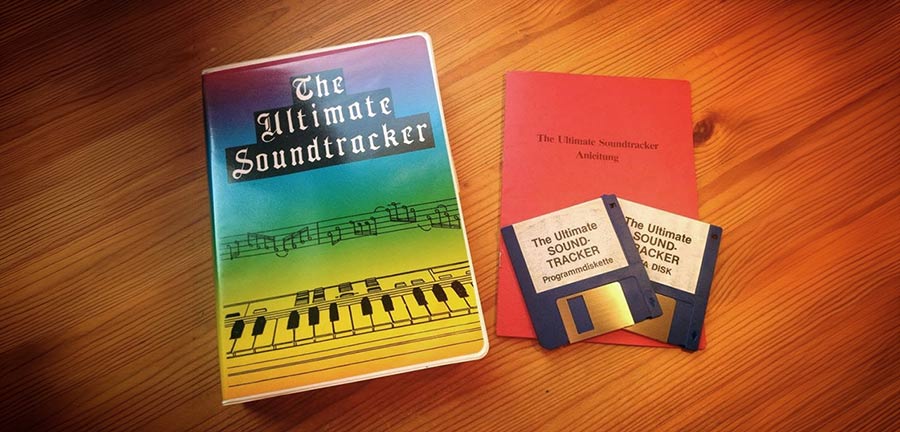
The first amiga tracker
The ST-01 Sample Disk
Soundtracker shipped with a companion floppy disk of instrument samples, named ST-01. It contained 126 sampled waveform instruments, and it is genuinely difficult to overstate how central this one small collection of sounds became to the sonic identity of an entire computing platform. These sample disks were distributed alongside the trackers under sequential names — ST-01, ST-02, and so on.
The sounds on ST-01 were not synthesized by Obarski from scratch; they were recorded from a handful of popular commercial synthesizers and drum machines of the era, most notably the Roland D-50 and the Yamaha DX21, with additional material drawn from the Casio CZ-101 and the Roland Juno-106. Researchers who later traced the individual patches have matched at least twenty of the ST-01 sounds back to specific factory presets on the Roland D-50 — instruments with names like "Digiharp," "Fantasia," "Pizzagogo," "Staccato Heaven," and "Soundtrack," which Obarski relabeled or shortened for his own disk. Obarski has stated he sampled much of this material personally from his own Yamaha DX21, according to his documentation for the disk.
Because ST-01 and its follow-up ST-02 were the free, bundled starting point for essentially every new tracker user, thousands of aspiring Amiga musicians built their earliest songs entirely out of the same 126-odd sounds — which is precisely how those samples became "the sound of the Amiga" for years. If you played an Amiga game or watched a demo from roughly 1988–1990, there's a strong chance you heard a Soundtracker preset — a plucked bell tone, a synth stab, a particular snare hit — recur across dozens of unrelated productions, simply because everyone had access to the same disk. Longtime Amiga scene commentator "Mahoney" and others have noted that despite thousands of musicians using the exact same ST-01 instrument set, almost none of them could replicate the specific feel of Obarski's own compositions — the samples were shared, but his musicianship wasn't.
The ST-01 and ST-02 samples have outlived the Amiga itself. Preservationists have re-archived the original ST-xx disks from Aminet and converted them to modern WAV format specifically to keep this piece of computing and music history accessible, describing the goal as preserving the cultural influence the Amiga's Paula sound chip and its tracker software had on electronic music. Devoted fans have even released full "album" projects built entirely from ST-01 and ST-02 sounds, featuring both scene veterans and younger producers reinterpreting the same handful of 1987 patches.
Obarski's Own Music
It's easy to lose Obarski the composer behind Obarski the toolmaker, but he was, by most accounts, a genuinely distinctive Amiga musician in his own right. Obarski followed his own suggested discipline of assigning percussion, bass, lead, and accompaniment to separate channels, and his personal style proved difficult for other early composers to emulate — even though hundreds of them were working with the exact same ST-01 instrument set, none of them quite managed to recapture what Obarski achieved with it. His work on games like "Amegas" "Rallye Master" and "Sleepwalk" is described as instantly identifiable, sharing a consistent style and spirit. One retrospective goes as far as comparing his role in Amiga music to that of Rob Hubbard, the legendary Commodore 64 composer, for the C64 scene.
Obarski scored a number of Amiga games during this period for reLINE Software, Rainbow Arts, and EAS Software, among others, and his musical tastes reportedly ran toward Queen, Genesis, Electric Light Orchestra, and Jean-Michel Jarre, with a preference for harmony-driven, largely instrumental writing; among his own tracks, he singled out the Oil Imperium soundtrack, the title and in-game music from Dyter-07, and "track 3" of Rotator as personal favorites. He also left a small, playful signature in some of his games — hidden text in Crystal Hammer, Rallye Master, and Sarcophaser reading "Here waz the Muzak Wizzard and his SoundTracker II at work."
Life After Soundtracker
By the time Noisetracker arrived from Swedish programmers Mahoney & Kaktus in 1989 to a rapturous reception — ironing out many of the original's more troublesome bugs and, crucially, lifting the instrument-count ceiling from 15 to 31 — Obarski had already moved on to writing a different program, one that, sadly, was only ever used once and never released.
He continued to work in and around the Amiga scene through the early 1990s: on June 14, 1989, he wrote up instructions on how to wire a joystick for the PC Engine; he co-designed a program called Window Wizard and programmed its DOS version; and in 1991 he contributed ideas to Sonic Arranger, another Amiga music tool. Sometime after early 1992, he left reLINE following a dispute with the company's founder, Holger Gehrmann. In January 1993, he teased a "big surprise" for Amiga, Mega Drive, and Super Magic Drive owners, though details of this are scarce. As of a 2001 interview, Obarski reported that he had moved into electronics work, occasionally still writing test programs, and said he specifically disliked techno and hip-hop — along with his own earliest, "poor" MOD compositions.
By the mid-1990s, Obarski had effectively vanished from the scene he'd started. One retrospective, published on the well-known scene archive textfiles.com, calls him "possibly THE most elusive Grandfather of the Amiga" noting that despite practically inventing the concept of the tracker and composing some of the most memorable music the platform ever produced, he simply disappeared without a trace, and calling his absence "a real tragedy" for the community that owed him so much. Fans did eventually track him down enough to run a "Karsten Obarski Tribute Project" in February 2001, and the Amiga Music Preservation project conducted interviews with him in late 2001 and again in 2007.
From One Buggy Program to an Entire Musical Format
The technical legacy of the Ultimate Soundtracker is really the legacy of the .MOD file — a format that, remarkably, is still functional and still actively used today, nearly forty years on.
The interface Soundtracker pioneered — instruments plus pattern data, laid out as scrolling tracks — became the de facto standard for game sound production on the Amiga, even as Obarski's original commercial version was elbowed aside. The format evolved rapidly through its many unauthorized descendants: Soundtracker 2.0 was itself based on an intermediate derivative called Master Soundtracker 1.0, and successive versions refined details like how "repeat offset" values were stored — in bytes for versions 2.0 through 2.4, switching to word-based storage from 2.5 onward — while Soundtracker 2.3 raised the instrument ceiling to 31 samples and 2.4 introduced the now-famous "M.K." marker in the file format, contributed by a scener known as Unknown/DOC, which module players still use today to identify that file layout.
Noisetracker in 1989 and ProTracker in 1991 represent the two major evolutionary leaps beyond the original — with ProTracker in particular becoming the definitive, most widely used Amiga tracker of the format's golden age. "4-1">The music these programs produced, saved as MOD files, delivered surprisingly high audio quality for remarkably little disk space — a serious advantage before MP3-grade compression existed and floppy disk capacity was extremely limited — and MOD music went on to shape the aesthetic of the demoscene profoundly, with productions like Future Crew's celebrated 1993 PC demo "Second Reality" carrying the tracker sound (and, in that case, tracker-style looping techniques) well beyond the Amiga itself and onto the PC.
A whole ecosystem of alternative tracker-adjacent tools grew up alongside the Soundtracker lineage during the same years — Future Composer, Scoopex's SIDMON (later reworked as "The Musical Enlightenment"), Brian Postma's Sound Mon, and Chris Hülsbeck's more sophisticated TFMX system, which used programmable "sound macros" to manipulate timbre frame by frame. As the format spread to the PC in the early 1990s alongside the rise of affordable sound cards, it culminated in tools like Scream Tracker, and later, even more capable Amiga programs such as Digi Booster Pro and OctaMED Sound System, plus PC-native successors Fast Tracker 2 and Impulse Tracker — with Impulse Tracker in particular becoming the demoscene's dominant music tool on the PC.
The Community and Culture Obarski Unknowingly Founded
The most striking thing about Obarski's legacy is how thoroughly the format outgrew and obscured its own inventor. Later generations of musicians who grew up on tracker software often had no idea a single person — let alone a name — sat behind the idea. Decades later, a Unix/X11 open-source tracker program was named, quite deliberately, "SoundTracker" as a direct homage — its creators explicitly describing it as "a tribute to Karsten Obarski, who released his Ultimate Soundtracker program for the Amiga in 1987 and thus unknowingly founded the basis of a huge free-music movement." That description captures the irony precisely: Obarski never set out to start a movement, and arguably never benefited from the one he started, but the "arrange samples on tracks and patterns" paradigm he introduced became so fundamental that it's simply called "tracking" today, largely stripped of its Soundtracker branding.
Academic historians of game audio and chiptune culture have singled out exactly what made the format so consequential. Scholars Kevin Driscoll and Joshua Diaz, writing on the history of chiptunes, argue that the single most important thing Soundtracker did was give non-programmers direct access to sophisticated music-making tools built into their home computers, without requiring them to learn a programming language first. That's a small sentence for an enormous shift: before Obarski, making digital music on a computer was a programmer's task. After him, it was a musician's task — full stop. That democratization is arguably the single throughline connecting Ultimate Soundtracker to every piece of accessible music software that followed it, tracker or otherwise.
The community itself was defined from its very earliest days by piracy, reverse-engineering, and open, uncredited iteration — a culture that, whatever its ethical shortcomings toward Obarski personally, ended up producing an extraordinarily fast and collaborative pace of software development. The illegal sharing of Soundtracker's playroutine code is described by one scene historian as the spark that triggered a "Cambrian explosion" of tracker software — a burst of parallel, competing evolution that a single commercial company could never have matched. That remix culture, once set loose, proved durable: open module files circulated freely worldwide through the 1990s and beyond, and the tracker sound eventually bled into genres far removed from the Amiga demoscene, including gabber and breakcore, IDM, and UK hardcore and drum and bass. A number of well-known electronic musicians got their start specifically on tracker software descended from this lineage — Brothomstates on ScreamTracker, and deadmau5 and Machinedrum both on Impulse Tracker — while ProTracker and OctaMED became staples among UK hardcore and jungle producers working directly on Amiga hardware.
Conclusion
Karsten Obarski's place in music-technology history is a strange, almost paradoxical one: he built the foundation of an entire genre of software and, by extension, shaped the sound of an entire era of electronic and game music — and then largely vanished, uncredited, while his community iterated past him without him. The Ultimate Soundtracker was a commercial failure by every conventional measure. It crashed too often, it sold poorly, and its author couldn't even get his own bug reports acted upon by the community he'd inspired. And yet the core idea — samples arranged on tracks, bundled with pattern data into one portable file — proved durable enough to survive four decades, several complete changes of computing hardware, and a total generational turnover of the musicians using it.
The 126 sounds on the ST-01 disk, recorded off a Roland D-50 and a Yamaha DX21 in a German bedroom in 1987, ended up as the sonic wallpaper of an entire computing platform's golden age — and are still being sampled, referenced, and lovingly preserved by hobbyists today. That's an unusually long shadow for a program its own author considered, by his own account, a failure. Karsten Obarski may be one of the least-known inventors in the history of music software, but almost every piece of modern tracker software — and a surprising amount of electronic music more broadly — still carries his fingerprints.