The Soundtracker history: How everything began
There is a kind of music that most people have never heard, composed by artists most people have never heard of, for an audience that judges it with a rigour most concert halls could never match. It lives inside executable files a few kilobytes in size. It has shaped electronic music, video game audio, and modern sound synthesis in ways that go largely uncredited. This is the music of the demoscene — and its story is inseparable from the story of the computers that made it possible.
The demoscene is a subculture of programmers, graphic artists, and musicians who create "demos": self-contained audiovisual programs designed to push hardware to its absolute limits, with no gameplay and no practical purpose other than to be astonishing. Since its emergence in the early 1980s, music has never been an afterthought in this world. It has always been the pulse.
Origins: The Crack Intro and the Birth of Scene Music (1980–1985)
The demoscene did not begin as an art movement. It began as software piracy.
In the early 1980s, groups of enthusiasts cracking copy protection on commercial games for the Commodore 64, Apple II, and Atari 8-bit computers began attaching small programs to the start of their releases — "crack intros" or "cracktros" — that displayed a scrolling text greeting, announced the name of the cracking crew, and, crucially, played a tune. These intros were a signature, a boast, and a competition all at once.
Music was essential from the very beginning, for a simple reason: silence felt like failure. If you could make the machine sing while doing something visually impressive, you proved mastery. The programmers writing these intros were often the same people writing the music, and both had to fit into an absurdly small memory footprint.
On the Commodore 64, the chip doing the singing was the SID (Sound Interface Device), designed by Robert Yannes and introduced in 1982. The SID was genuinely remarkable: three independent oscillator voices, each capable of multiple waveforms (sawtooth, triangle, pulse, noise), a resonant filter, ring modulation, and hard sync between oscillators. It sounded like nothing else on the consumer market. Composers who learned to exploit it — manipulating the filter sweep in real time, using the noise channel for percussion, abusing the hardware to produce sounds far beyond its specification — created a distinctive aesthetic that remains beloved to this day.
The Golden Era: Commodore 64 and the Rise of the SID Composer (1985–1990)
By the mid-1980s, the crack intro had evolved into the standalone demo, and the music scene around it had produced its first genuine stars.
Rob Hubbard became arguably the most influential composer of this period. Working within the SID's three voices, he constructed arrangements of extraordinary complexity — dense arpeggios that implied chords, driving basslines, melodic leads, and dynamic percussion all woven together simultaneously. His soundtracks for games like Monty on the Run (1985) and Sanxion (1986) were not merely functional; they were technically astonishing and emotionally affecting. Hubbard famously exploited SID hardware quirks that the chip's designers had not intended as musical features, discovering that certain combinations of register writes produced sounds Yannes had never anticipated.
Martin Galway brought a different sensibility — cleaner, more melodic, more influenced by contemporary pop and new wave. His work on Parallax (1986) and Wizball (1987) demonstrated that the SID could be lyrical and warm, not just aggressive and percussive.
Jeroen Tel, Chris Hülsbeck, and Ben Daglish rounded out a generation of composers who treated the SID as a legitimate instrument demanding mastery. The scene that surrounded them was intensely competitive: a new demo release was evaluated not just on its visual effects but on whether the music was worthy of those visuals.
The tool of choice for this era was not software in any modern sense. Composers worked directly in assembly language, writing routines that manipulated the SID's hardware registers at the interrupt level — typically 50 times per second on PAL machines. A "music player" was hand-written code. The idea of a graphical interface for music composition was a luxury the early scene could not afford and did not especially want.
Expansion: The Amiga and the Tracker Revolution (1987–1993)
Everything changed with the Commodore Amiga.
Released in 1985, the Amiga contained a custom chip called Paula, which could play back four channels of 8-bit sampled audio simultaneously. Unlike the SID, Paula did not synthesize sounds from oscillators — it replayed recorded waveforms stored in memory. This meant that, in principle, any sound imaginable could be played back, as long as it had been recorded and fit within the machine's RAM.
The question was how to compose with sampled audio in an environment where memory was precious and sequencing tools barely existed. The answer was the tracker.
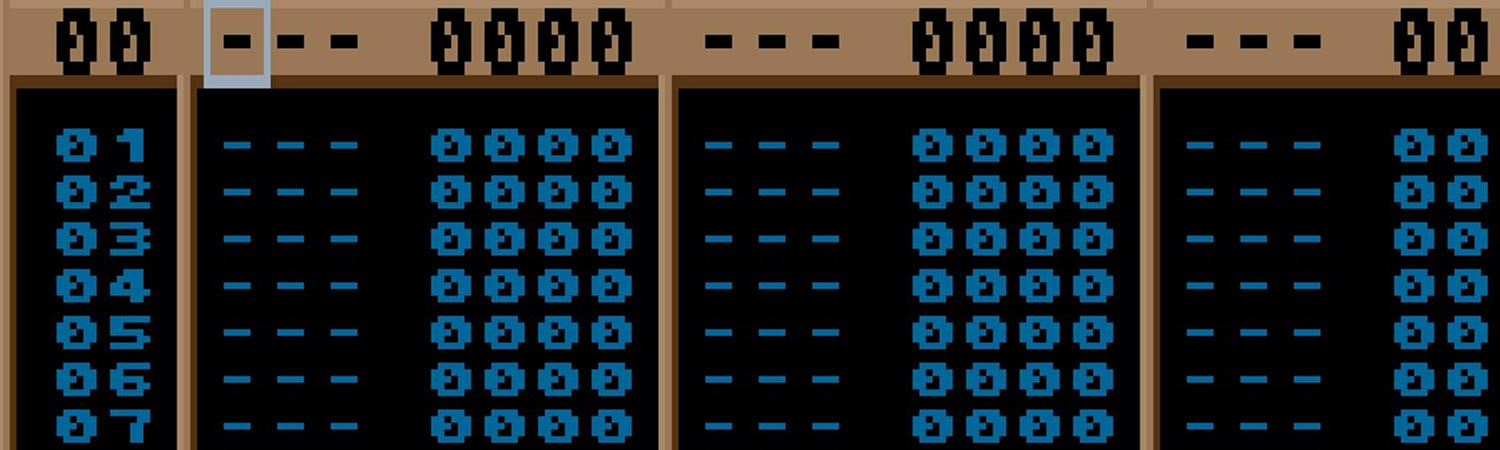
The Ultimate Soundtracker, written by Karsten Obarski and released in 1987, established the paradigm. A tracker presented music as a vertical grid: columns represented channels, rows represented time steps (called "ticks" or "rows"), and each cell contained a note value, a sample number, and an effect command. The composer scrolled down through the pattern in real time as the music played, editing values directly. The resulting file format — the .MOD file — embedded both the pattern data and the audio samples into a single, self-contained package.
The MOD format was a revelation. A single file contained everything needed to play the music on any compatible machine. It could be copied, shared, posted on bulletin boards, and played back with a compatible player. The scene embraced it immediately.
What followed was an explosion of tracker software, each generation more capable than the last:
Soundtracker gave way to Noisetracker (1989), which added more effects. Protracker (1990) became the standard, offering four channels, 31 instrument slots, and a rich set of effects including vibrato, portamento, volume slides, and pattern loops. For several years, Protracker was simply what you used on the Amiga. Full stop.
The musicians who emerged from this environment were not working with pre-existing genre conventions. They were inventing new ones. The Amiga demoscene produced a style of music — dense, fast, melodically intricate, influenced simultaneously by heavy metal, synth-pop, and classical composition — that had no name at the time but would eventually be called chiptune (loosely) or simply "scene music."
Key composers of this era included Purple Motion (Jonne Valtonen), whose work with the group Future Crew defined the sound of the early 1990s scene; Skaven (Peter Hajba), whose emotional depth and compositional sophistication elevated the form; and Moby, who began his career as a demoscene musician before crossing over to commercial success. The scene was a genuine training ground.
The PC Era and the Extension of the Format (1990–1997)
As the IBM PC and its clones gained dominance in the early 1990s, the scene faced a musical crisis. The PC's standard sound hardware — the PC speaker, capable of producing only a single square wave at a fixed volume — was laughably primitive compared to the SID or Paula. Early PC demos were, by the standards of their Amiga contemporaries, sonically impoverished.
The solution came in stages.
AdLib and then Sound Blaster cards from Creative Labs became the de facto standard for PC audio by the early 1990s. The AdLib used an OPL2 FM synthesis chip (the OPL3 followed); the Sound Blaster added digital audio playback. Both required software to address them directly, and the scene wrote that software.
OPL-based composition was formalized through the .OPL and IMF formats, but more significant was the development of the .S3M (Scream Tracker 3 Module) format by Future Crew in 1990, which extended the MOD paradigm to support up to 32 channels and the Sound Blaster's digital output. Impulse Tracker followed in 1995 with the .IT format, adding even greater expressiveness and becoming the dominant tracker for advanced PC compositions.
The other major development was MIDI and the General MIDI standard (1991), which allowed composers to write music that referenced a standardized instrument bank. While MIDI was more common in commercial game audio than in the demoscene proper, it influenced scene composers who worked across both worlds.
FastTracker 2 (1994), developed by Triton, introduced the .XM (Extended Module) format, which added 16 channels and became one of the most widely used tracker formats of the decade. Its interface was clean, its feature set comprehensive, and its output portable. FastTracker 2 remained the tool of choice for a generation of composers well into the late 1990s.
By the mid-1990s, the PC demoscene had not merely caught up with the Amiga — it had surpassed it. Events like Assembly in Finland and The Party in Denmark drew thousands of attendees. The music competition at these "demoparties" was a serious affair, judged by a crowd of thousands with strong opinions and exacting standards.
The Digital Audio Workstation and Scene Integration (1997–2005)
The late 1990s brought a fundamental shift in how scene musicians worked. As personal computers became powerful enough to process audio in real time, commercial DAW (Digital Audio Workstation) software — Cubase, Logic, Ableton Live — became accessible to hobbyists. The boundary between "scene tools" and "professional tools" began to dissolve.
This created tension. The tracker aesthetic — its particular rhythmic grid, its sample-based timbre, its cultural associations — was distinct from the smoother productions emerging from DAW-based composers. Some scene musicians embraced DAWs enthusiastically, producing music that could compete with commercial releases on technical terms. Others saw the tracker as a constraint worth preserving, a discipline that forced creativity.
The .mod ecosystem also faced change. OpenMPT (Open ModPlug Tracker), released initially as ModPlug Tracker in 1997 and open-sourced in 2004, brought tracker composition to Windows in a modern, accessible interface while retaining compatibility with classic formats. It remains actively developed and widely used today.
In parallel, the constraints of the demoscene itself drove a new form of musical innovation: 4K and 64K intros. These were demos where the entire executable file — graphics, code, and music — could be no larger than 4,096 or 65,536 bytes. At those sizes, storing audio samples was impossible. Instead, composers turned to procedural audio synthesis: writing synthesizer engines from scratch, in code, that generated all sounds mathematically at runtime.
This led directly to the development of tools like 4klang and Clinkster — software synthesizers designed specifically for size-constrained productions, capable of producing rich, expressive audio from a handful of kilobytes of code. Composing for a 4K intro required understanding synthesis at a level that most professional musicians never needed to consider.
The video that explains everything
Platforms and Software: A Reference
Hardware Platforms
| Platform / Chip | Year | Description & Tools |
|---|---|---|
| Commodore 64 / SID chip | 1982 | Three-voice synthesizer with resonant filter. The definitive 8-bit music platform. SID composition required direct register manipulation in assembly. Modern tools like GoatTracker and SIDTracker 64 allow contemporary composers to work in the SID format. |
| Commodore Amiga / Paula chip | 1985 | Four-channel 8-bit sample playback. The birthplace of the tracker paradigm. Protracker, Noisetracker, and OctaMED were the defining tools. |
| Atari ST / YM2149 | 1985 | The Atari ST used a simpler three-voice chip (the AY-3-8910 variant), but its built-in MIDI ports made it unexpectedly important as a composition and sequencing platform. Many professional studios in the late 1980s and early 1990s used the ST as a MIDI sequencer. |
| IBM PC / OPL2, OPL3, Sound Blaster | 1987–1994 | FM synthesis followed by digital audio. The OPL chips were used extensively in game music; the Sound Blaster enabled tracker playback on PC. |
| Game Boy / DMG | 1989 | Four channels: two pulse waves, one wave channel, one noise channel. Became a cult instrument for chiptune composers in the 2000s, with LSDJ (Little Sound DJ) as the primary composition tool. |
Software and Formats
- Ultimate Soundtracker (1987) — Karsten Obarski. The origin of the tracker paradigm and the .MOD format.
- Protracker (1990) — The canonical Amiga tracker. Defined four-channel MOD composition.
- Scream Tracker 3 (1990) — Future Crew. Introduced the .S3M format, enabling PC tracker composition beyond four channels.
- FastTracker 2 (1994) — Triton. The .XM format, 16 channels, widely adopted for PC scene music.
- Impulse Tracker (1995) — Jeffrey Lim. The .IT format, extremely expressive, favoured by advanced composers.
- Renoise (2002–present) — A modern tracker with a DAW-style interface, VST support, and contemporary production capabilities. Widely used in the contemporary scene.
- OpenMPT / ModPlug Tracker (1997–present) — Windows tracker supporting virtually all classic module formats plus modern extensions.
- 4klang (2007–present) — A software synthesizer designed for size-constrained intros, generating audio procedurally.
- Clinkster — Another procedural synthesizer for size-limited productions.
- LSDJ (Little Sound DJ, 2000–present) — Game Boy composition software. Became the dominant tool for portable chiptune performance.
- Famitracker (2005–present) — NES/Famicom music composition, using the 2A03 sound chip's capabilities.
The Contemporary Scene (2005–Present)
The demoscene has not faded. If anything, it has diversified.
Demoparties like Revision in Germany, Evoke, Solskogen, and the long-running Assembly continue to draw competitors and spectators. The music competitions at these events have grown more sophisticated, now typically divided into categories: tracked music, streamed (DAW-produced) music, chiptune, and sometimes category-specific contests for particular platforms.
The chiptune movement — which overlaps with but is not identical to the demoscene — has grown into a genuine performance genre, with artists like Anamanaguchi, Sabrepulse, and Chipzel achieving mainstream recognition. The SID chip has its own annual festival. Game Boy music has a vibrant live circuit.
Within the scene proper, the tension between constraint and possibility remains generative. Size-coding competitions push composers to achieve more with procedural synthesis than seemed conceivable a decade ago. Modern 64K intros contain music that would not sound out of place in a commercial production, generated from a file smaller than a typical email attachment.
Archival and preservation efforts have also matured. HVSC (High Voltage SID Collection) maintains over 50,000 SID tunes. The Mod Archive hosts hundreds of thousands of tracker files. Demozoo and Pouet catalogue the productions themselves, ensuring that this peculiar art form is not lost to bit rot and obsolescence.
Conclusion
The music of the demoscene represents one of the most technically demanding and aesthetically coherent traditions in the history of electronic music. It emerged not from conservatories or recording studios but from the constraints of early home computers — from the specific character of the SID chip, from the four channels of Paula, from the impossibly small memory budgets of crack intros.
Those constraints produced not limitation but invention. The composers who worked within them — Hubbard, Galway, Purple Motion, Skaven, and thousands of others — developed techniques, aesthetics, and entire genres that quietly shaped everything from video game audio to the wider world of electronic music. The tracker, invented as a tool for fitting music into a floppy disk, became an instrument in its own right.
The scene's music has always been, at its core, a dialogue between human creativity and machine limitation. As machines have grown more powerful, the most interesting work has often come from composers who deliberately choose the older constraints — who reach for a SID chip or a Game Boy in an era of unlimited samples — because they understand that limitation is not the enemy of expression. It is frequently its source.
Further listening:
- The HVSC (High Voltage SID Collection) at hvsc.c64.org
- The Mod Archive at modarchive.org
- scene.org for demo releases and associated music.