Renoise and the Modern Tracker Revival
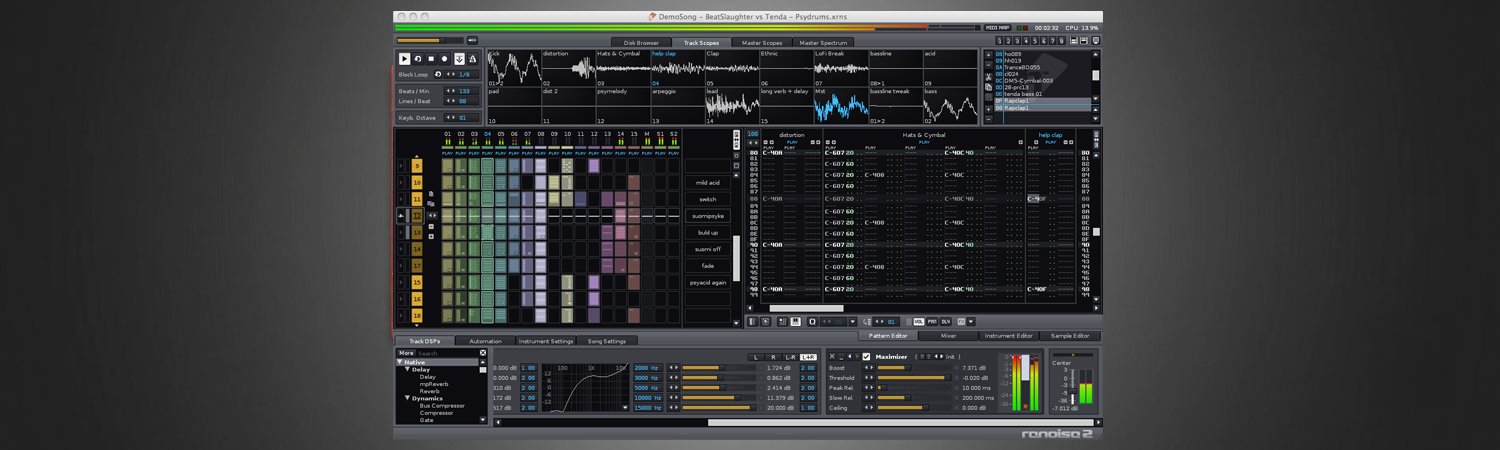
How a small team of scene coders kept the pattern-based workflow alive — and turned it into a full production tool
By the late 1990s, the golden age of the tracker seemed to be winding down. FastTracker 2 and Impulse Tracker had defined PC composing through the DOS years, but as Windows took over and glossy sequencer-style DAWs like Cubase and Cakewalk became the standard, the pattern-based, keyboard-driven tracker interface started to look like a relic of a previous era. What actually happened was different: rather than disappearing, the tracker format found a second life, rebuilt from the ground up for modern audio production. Renoise is the clearest example of that second life, and it remains the flagship of what's often called the modern tracker revival.
Starting From NoiseTrekker
Renoise didn't begin as an entirely new idea — it began as an improvement on an existing one. In the late 1990s, Spanish coder Juan Antonio Arguelles Rius, known in the scene as Arguru, built a DOS/Windows tracker called NoiseTrekker. When Arguru decided to stop developing it and released the source code publicly, two scene members independently saw an opportunity. Zvonko Tesic ("Phazze") started reworking the NoiseTrekker code around December 2000. A few months later, Eduard Müller ("Taktik") reached out, having been quietly improving the same codebase on his own. The two joined forces, and what became Renoise was born from that collaboration.
Their goal was ambitious: bring the tracker interface — the vertical, pattern-based sequencing grid that had defined the format since Karsten Obarski's Ultimate Soundtracker in 1987 — up to a level of audio quality and flexibility that could compete with professional, non-tracker software. Renoise's first stable version, 1.0, was released in June 2002.
Old Interface, New Engine
What made Renoise stand apart from most of its DOS-era ancestors wasn't the layout — musicians coming from FastTracker 2 or Impulse Tracker would recognize the vertical pattern editor almost immediately — it was everything running underneath it. Renoise added support for VST and Audio Unit instrument and effects plugins, MIDI and OSC hardware control, ReWire integration with other DAWs, and a proper multitrack mixing and automation engine, all while keeping the fast, precise, keyboard-first editing that tracker musicians relied on. It effectively asked a question the DOS trackers never got the chance to: what if a tracker didn't have to choose between the old workflow and modern studio-quality sound?
Over the following two decades, the tool kept expanding. A built-in Lua scripting API opened the door to community-built tools and extensions. A companion plugin, Redux, brought Renoise's sampler and sequencing engine directly into other DAWs as a VST/AU instrument. The project has stayed in active, independent development since 2002 — an unusually long lifespan for a piece of scene-born software, sustained by a small team and a loyal user base rather than a large publisher.
Not the Only Survivor
Renoise is the best-known name in the modern tracker space, but it's far from alone. OpenMPT carries the torch as a free, open-source continuation of the classic ModPlug Tracker, staying closer to the original DOS-tracker feel while adding modern file and plugin support. MilkyTracker and Schism Tracker aim squarely at preserving the FastTracker 2 and Impulse Tracker experience for musicians who want the original interfaces, bugs and all, on current operating systems. On dedicated chip-music hardware and emulators, tools like FamiTracker (built around the NES's sound hardware) and Little Sound Dj — a tracker that runs directly on an actual Game Boy cartridge — carried the format into console and handheld chip music long after the Amiga and PC scenes had moved on. Even outside dedicated tracker software, the pattern-based mindset has left its mark on tools like SunVox, which combines a tracker-style timeline with modular synthesis.
Why the Format Refused to Die
Part of the tracker's staying power is practical. Entering notes, effects, and volume changes as text in a grid is fast once learned, and it's precise in a way that mouse-driven piano-roll editors often aren't — a tracker musician can build a complex pattern almost entirely without touching a mouse. Part of it is cultural: the tracker format grew up inside the demoscene, and the demoscene never really left. Trackers — Renoise very much included — are still a common sight in modern demo productions, chiptune albums, and livecoding performances, carrying the same core idea Obarski and his successors established in the 1980s into an entirely different technical era.
There's also something the format offers that few modern DAWs replicate well: a genuinely lightweight, low-latency way of building dense, rhythmically intricate music, which is part of why trackers remain popular in genres like drum and bass, chiptune, and other electronic styles built on tight, repeating patterns.
A Living Lineage
What's notable about Renoise's history is how directly it traces back through the format's entire lineage — from Obarski's original Soundtracker, through the DOS-era giants like FastTracker 2 and Impulse Tracker that shaped its interface, to a scene coder's abandoned project that two other scene coders decided was worth finishing properly. More than twenty years after that first 2002 release, Renoise is still developed, still updated, and still used by musicians who want the tracker's speed and precision without giving up modern production tools. It's a rare case of scene software growing up without losing what made it worth keeping in the first place.
Further reading
- Renoise — Wikipedia
- Who We Are — Renoise.com
- Renoise: The Second Coming for Trackers — Hugi Diskmag interview with Phazze
- The History of Trackers — MusicTech
- tracker-history: Renoise — GitHub archive