Yamaha OPL2/OPL3 and AdLib: FM Synthesis on Early PCs
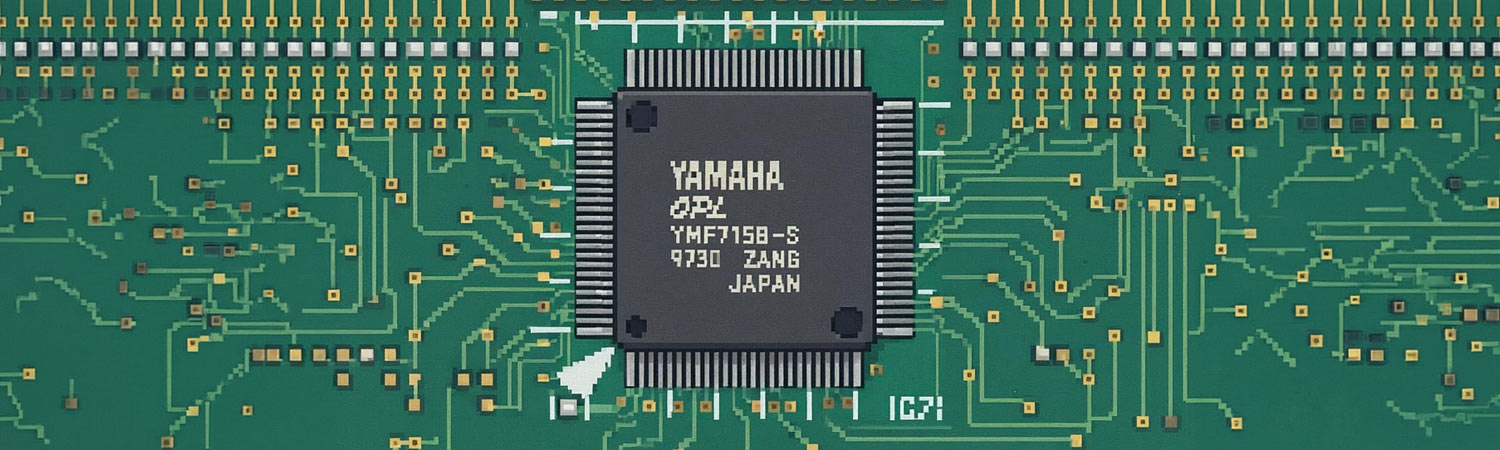
How a chip built for math, not music, became the sound of an entire era of PC gaming
Before wavetable cards could play back real recorded instruments, PC games made music by calculating it, note by note, using a technique borrowed from professional synthesizer keyboards called FM synthesis. The chip that brought this to home computers, Yamaha's OPL family, and the sound card that first put it inside a PC, AdLib's Music Synthesizer Card, defined the sound of DOS gaming for roughly a decade — a very different approach from the sample-playback path taken later by cards like the Gravis Ultrasound.
What FM Synthesis Actually Does
FM synthesis generates sound by using one waveform, the modulator, to rapidly shift the frequency of a second waveform, the carrier, many times each second. Instead of storing a recording of an instrument, the chip computes a waveform on the fly by combining a handful of sine oscillators with adjustable ratios and volume envelopes. The technique was developed by composer and researcher John Chowning at Stanford in the early 1970s and licensed to Yamaha, who built it into professional instruments like the famous DX7 keyboard before shrinking the same idea down into a low-cost chip for consumer electronics.
AdLib: The Card That Started It
The AdLib Music Synthesizer Card was released in August 1987 by the Quebec-based company AdLib, Inc., founded by former music professor Martin Prevel. At $219.99, it was the first FM sound card to gain real acceptance in the PC market, fitting into a standard 8-bit ISA slot and outputting audio through a simple onboard amplifier. Early boards even had their Yamaha chip's markings scratched off in an attempt to stop competitors from cloning the design — a precaution that didn't stop Creative Labs from building a compatible chip into its own Sound Blaster card a few years later.
The AdLib card's breakthrough moment came in 1988, when Sierra shipped an AdLib-supported soundtrack for King's Quest IV, giving players a clear, musical alternative to the PC speaker's thin beeps and demonstrating exactly what the card could do. Within a couple of years, AdLib support became a checkbox on the back of nearly every PC game box, and by the early 1990s roughly 1,800 titles supported the format.
OPL2: Nine Voices in One Chip
At the heart of the AdLib card sat the Yamaha YM3812, better known by its nickname OPL2 ("FM Operator Type-L, generation 2"). Released in 1985 and an improved version of the earlier YM3526, the OPL2 offered nine channels of two-operator FM synthesis, meaning each of its nine simultaneous voices combined just one modulator and one carrier oscillator. It could also switch into a mode that traded some of those voices for basic percussion instruments — bass drum, snare, tom-tom, cymbal, and hi-hat — useful for game soundtracks that needed a rhythm section. A companion DAC chip, the YM3014, converted the OPL2's digital output into an analog signal for AdLib's amplifier.
Because the OPL2 became the de facto standard once AdLib and, soon after, Sound Blaster both used it, it was effectively the only FM chip PC game composers needed to write for throughout the late 1980s and early 1990s.
OPL3: More Operators, Richer Sound
Yamaha followed up in 1990 with the YMF262, or OPL3, an upgraded, backward-compatible successor. Its headline feature was support for four-operator FM synthesis, letting a single voice chain two modulators and two carriers together for noticeably richer, more complex timbres — closer to the sound of contemporary Yamaha synth keyboards than the comparatively thin two-operator tones of the OPL2. The OPL3 also added four new waveforms on top of the original four, for a total of eight per oscillator, and could be configured to output in stereo.
The OPL3 shipped in the Sound Blaster Pro 2 and later Sound Blaster 16 cards, as well as AdLib's own AdLib Gold card, and remained the standard FM synthesis chip in PC sound cards until wavetable synthesis and digital sample playback took over as the dominant approach later in the 1990s.
A Different Philosophy From the Gravis Ultrasound
The contrast with sample-based cards is really a contrast in philosophy. An FM chip like the OPL2 or OPL3 never stores any actual recorded sound — every instrument is a mathematical description that the chip re-synthesizes in real time, which keeps the hardware and the music data extremely small but limits the realism of the result; listeners often describe classic OPL music as having a distinctive, slightly metallic or "buzzy" character. A wavetable-based card like the Gravis Ultrasound, by contrast, plays back short digital recordings of real instruments from onboard RAM, trading that compactness for a warmer, more natural sound at the cost of needing memory to hold the samples. Both approaches solved the same problem, squeezing convincing music out of limited PC hardware, from opposite directions.
Legacy
FM synthesis's PC dominance faded once digital sample playback became cheap enough for mainstream sound cards, but the OPL sound never really disappeared. Chiptune and demoscene musicians still compose for the OPL2 and OPL3 directly, software emulators such as Nuked OPL3 reproduce the chip's exact analog quirks in modern game engines and DOS emulators like DOSBox, and hobbyists have even built modern peripherals, like the parallel-port OPL2LPT, that plug real OPL2 silicon into current-day retrocomputing setups.
Learn more:- Yamaha YM3812 (OPL2/OPL3) — Wikipedia
- AdLib, Inc. — Wikipedia
- FM synthesis — Wikipedia
- Ad Lib Music Synthesizer Card — Video Game Music Preservation Foundation
- Hackaday: projects and deep dives on the OPL2 chip
- Nuked OPL3 — cycle-accurate OPL3 emulator
- OPL2LPT — a real OPL2 chip for modern PCs via the parallel port