How music competitions worked at demoparties
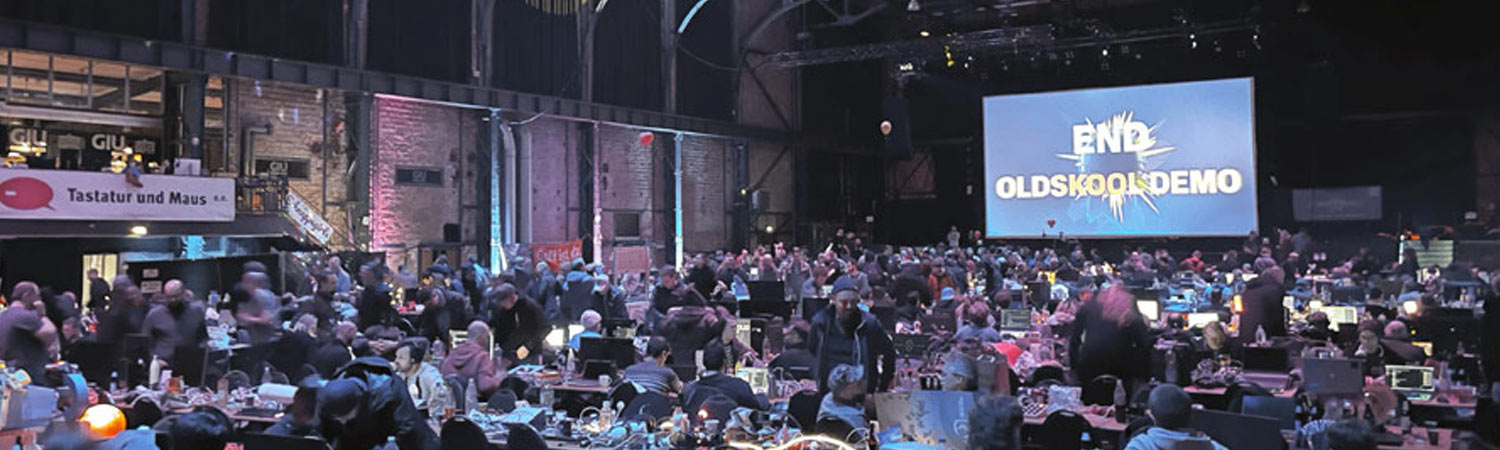
A look inside the demoscene's music compos — from tracked chiptunes to 64k synths
Long before streaming platforms and DAWs were everywhere, a subculture of programmers, artists, and musicians called the demoscene gathered at events called demoparties to show off what they could squeeze out of computer hardware. Alongside the famous "demo" and "intro" competitions (where coders competed to fit stunning audiovisual effects into tiny executable files), most parties also ran dedicated music competitions, usually just called "music compos." These gave composers a stage of their own, separate from the visual side of the demoscene.
How a Music Compo Actually Worked
Even though details vary from party to party, most music compos followed a fairly consistent routine:
- Submission before a deadline. Composers uploaded their tracks (as tracker modules, executables, or audio files, depending on the category) before a strict cut-off time, often the night before the compo was screened.
- Anonymous pre-selection. At larger parties with dozens or even hundreds of entries, a small team listened to everything in advance — without knowing who made each track — and scored it. Only the highest-rated pieces made it into the final live compo, to keep the show at a manageable length.
- Live playback in the compo hall. On the big night, the selected tracks were played one after another over the party's PA system to the full crowd, usually with the composer's handle displayed on the big screen (sometimes with a simple visualizer, sometimes just album-art-style slides).
- Audience voting. Attendees ranked or scored the entries, often on paper ballots in the old days and now almost always through the party's website or intranet.
- Results and prizes. Winners were announced at a prize-giving ceremony, earning bragging rights, sometimes actual prizes, and — most importantly — respect within the scene.
Because the audience judges music the same way it judges demos — live, together, in one room — a track that works as a piece of "performance" (building tension, landing a strong intro and outro) tends to do well, even more than a track that only sounds good on headphones.
The Main Competition Categories
Music compos are usually split into categories, partly by how the music was made and partly by what technical restrictions it had to obey. Here are the ones you'll see at most demoparties:
| Category | What it means |
|---|---|
| Tracked / Module Music | Composed in a "tracker" (software like OpenMPT, Renoise, or MilkyTracker) using sample-based formats such as MOD, XM, IT, or S3M. This is the most traditional demoscene way of writing music, dating back to the Amiga era. |
| Chiptune / Oldschool Music | Music written for, or in the style of, vintage 8-bit and 16-bit sound chips (Commodore 64's SID chip, Amiga's Paula chip, Game Boy, NES, etc.), often using authentic period-correct tools and hardware limitations. |
| Executable / Streamed Music (4k, 64k, etc.) | Music generated entirely by a tiny piece of code at runtime rather than stored as audio data — the whole "song" has to fit inside a few kilobytes of executable, using synthesizers built specifically for size-coding, such as 4klang or 64klang. This mirrors the famous 4k and 64k intro/demo size-coding competitions. |
| Multichannel Music | An older umbrella term (especially from the Amiga/PC era) for music composed with multiple independent audio channels/tracks mixed together — essentially another name for tracked module music, as opposed to single-channel chiptunes. |
| Freestyle / Newschool / "Any Format" Music | Open-format competitions with no tool or platform restrictions — electronic, orchestral, metal, ambient, whatever the composer wants — usually submitted as a rendered audio file (MP3, OGG, or similar). |
| Remix / Cover Compo | Composers rework a well-known demoscene classic or chiptune into a new arrangement or genre. |
| Live Acts / Concerts | Not a judged compo in most cases, but many parties give scene musicians a slot to perform live sets to the crowd, sitting alongside the formal competitions. |
Why the Size Limits Matter
The tiny-file categories (4k, 64k, and similar) exist because the demoscene grew up around extreme technical constraints. Just as a "64k intro" limits an entire audiovisual demo to 65,536 bytes of executable code, a 64k music entry has to generate its entire soundtrack from that same tiny budget — no pre-recorded samples, just algorithms, oscillators, and clever compression. It turns composing into a programming puzzle as much as a musical one, which is a big part of why these compos are so respected within the scene.
Famous Demoparties
Music compos happen at demoparties all over the world, but a handful of long-running events are considered the heart of the scene:
-
Assembly (Finland) — one of the oldest and largest demoparties, running
since 1992.
assembly.org -
Revision (Germany) — currently the largest "pure" demoparty in the world,
held every Easter in Saarbrücken/Bochum.
revision-party.net -
Evoke (Germany) — a mid-sized, well-loved party held in Cologne each
summer.
evoke.eu -
The Gathering (Norway) — originally a classic demoparty, now more of a large
general computer/LAN festival with a demoscene track.
gathering.org -
Deadline (Germany) — a smaller, community-focused party held in Berlin.
via demoparty.net listings -
Outline (Netherlands) — one of the longest-running Dutch demoparties.
outlinedemoparty.nl -
Under Construction (Germany) — a mid-sized party known for strong
executable-graphics and music compos.
underconstruction.rocks -
Lovebyte — an online-only party dedicated entirely to extreme size-coding,
with byte-sized music and graphics categories.
lovebyte.party -
Silly Venture (Poland) — the largest Atari-focused demoparty.
sillyventure.eu
General Resources
- demoparty.net — a running calendar of demoparties worldwide.
- pouet.net — the demoscene's main production database and community hub.
- demozoo.org — an extensive archive of demoscene productions and party results.
- SceneSat — an online radio and streaming station dedicated to demoscene music.
Compiled from demoscene community sources including Wikipedia, party rulebooks, and long-time scene write-ups. Party details (dates, venues) can change year to year — check each party's official site for the current edition.