Esa Ruoho, aka Lackluster: From demoscene chiptunes to a life in sound
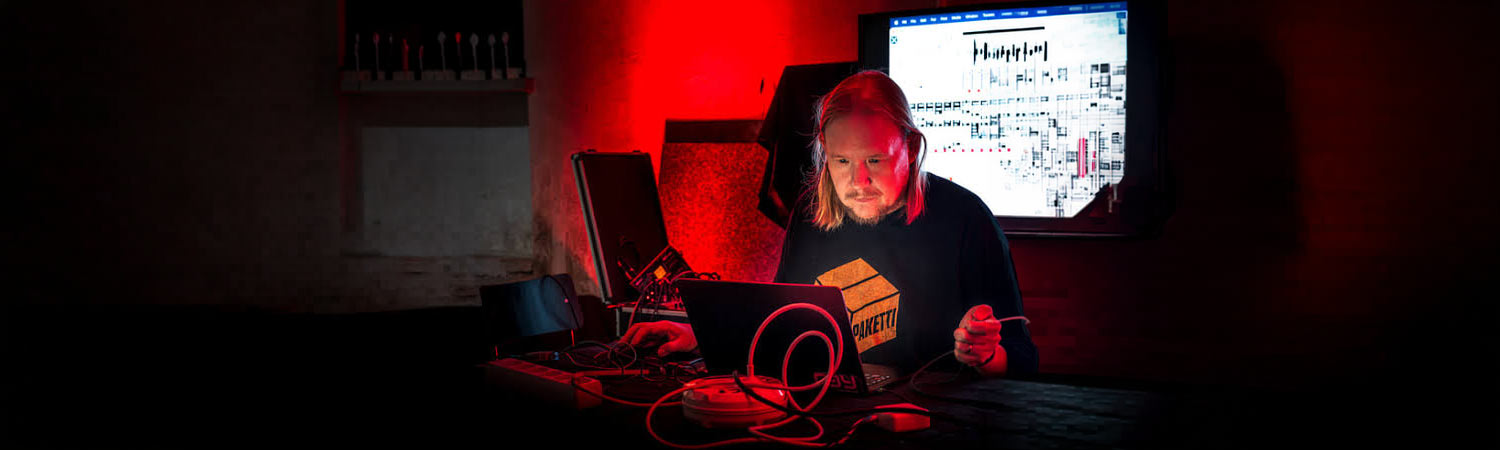
In the quiet, unglamorous suburb of Kontula in Eastern Helsinki, one of the most quietly influential figures in both the demoscene and the international IDM/ambient scene has spent over three decades making music. Esa Juhani Ruoho — born October 26, 1978 — is better known to the world as Lackluster, though he has recorded under a small constellation of other names too: Distance, XLLV, Can'O'Lard, Kökö and the Köks, and HLER. His catalogue now runs to dozens of releases across labels on three continents, but his story starts much earlier than any record deal — it starts with a modem, a bulletin board, and a tracker program.
The BBS Years and the Roots of a Musical Life
Long before streaming, or even before mp3s were common currency, Ruoho was running his own Bulletin Board System called Cloudcity, which he operated continuously from 1992 to 2000 — first on HectoBBS, then SuperBBS, and finally PCBoard. For a teenager in early-90s Helsinki, running a BBS was as much a technical education as a social one: it meant learning file formats, networking, community moderation, and — inevitably, for anyone hanging around that world — trackers and mod files.
This is the environment that produced the demoscene, and it's the environment that produced Ruoho as a musician.
Life in the Demoscene: Distance and the Group Years
Ruoho's earliest musical identity wasn't Lackluster at all — it was Distance, his handle as a chiptune and tracker musician active within several classic demoscene groups: bC!, Orange, Monotonik, Calodox, The Digital Artists, The Planet of Leather Moomins (TPOLM), FLO, and Satori. These groups were the backbone of a particular strain of the European demoscene through the mid-to-late 1990s, producing tracked music modules (.mod, .s3m, .it files) that were traded, compiled.
Lackluster performed twice live at demoparties in 2007. At the Assembly 2007 and the Altparty 2007
The name "Lackluster" itself was born directly out of demoscene logistics. In an interview with Igloo Magazine, Ruoho explained that he needed a name to release music under as an individual, separate from Orange, because — in his own self-deprecating words — he felt he was clearly the weakest musician of the five in that group. So "Lackluster" was picked almost as a joke about his own modesty, and it stuck for the next thirty years and still.
Groups like Monotonik were particularly important.
Monotonik started with .mod files in zip/lha format later s3m xm .it and slowly moved to mp3 only.
Then, Monotonik operated as an early "net-label" before that term existed and freely distributed CD-Rs and compilations rather than pressed vinyl or CDs, which fit naturally with the DIY, non-commercial ethos of the scene.
Monotonik released only one CDR. The one from Lackluster : CDR#2
A cache of early Lackluster tracker material was, in fact, only ever released this way pressed in a run of about 100 CD-Rs through Monotonik and circulated among scene contacts rather than sold commercially.
If you want to see the raw archaeology of this period, Distance/Orange's demo discography documents his tracker-era productions, and his group affiliations can still be traced today through community-run archives like Demozoo and Poüet.net, the demoscene's central hub for rating and cataloguing productions. One notable example of his crossover into the visual side of the scene is a music video collaboration with Finnish graphics artist Pauli Ojala on the track "13/10/99," which competed in the Assembly 2001 demoparty's Wild demo competition, finishing 4th — Assembly being, and still being, one of the largest and most storied demoparties in the world.
In the other hand, Lackluster collaborations with Replay produced some of the more memorable, and later on released on vinyl + cd tracks like catch22, clinique, etc.
This period gave Ruoho something that would define his whole later career: a musician's fluency with constraint. Tracker music forces composers to work with tiny sample banks, byte-level sound design, and rigid sequencing grids — skills that translate directly into an ear for melody and texture that doesn't need studio polish to land emotionally. Longtime scene contemporaries have noted that his tracker-era back catalogue was substantial enough that other musicians occasionally asked him — sometimes controversially — about extracting old samples from his own decades-old module files, a small but telling sign of how deep his tracker archive runs.
The Turn to Lackluster: IDM, Ambient, and a Prolific Solo Career
Around 1999–2000, as the demoscene's home-grown mp3 and net-music culture began merging with the wider electronic underground, Ruoho started releasing music as Lackluster in a more conventional sense: EPs and albums for actual labels, rather than tracker modules passed between scene friends. Early full-lengths like CDR#1 and CDR#2 (1999) and the first 12" EP on deFocus Records, FOC349 release (2000) mark this transition point, and the Foc349 release notes describe the material as growing directly out of those hand-pressed, 100-copy demoscene CD-Rs.
FOC354 "R U Oho?" 12" is notable simply because it featured two (out of a total of three) remixes by Dune/Orange aka Brothomstates, a remix by Bauri (who released on Monotonik), Xhale (Erik Skodvin, who was also active on the demoscene) and oone (out of a total of four) remix by Sense, who also released on Monotonik. the unreleased set of remixes included such Monotonik notable as Vim! (Keith Baylis) and Tim Koch (Thug, of Monotonik fame) especially since the Brothomstates "Ix Pen" track was released later on his album on Warp Records, Claro.
From there, the releases came fast. Ruoho signed to a run of labels that, in retrospect, reads like a map of the early-2000s IDM/braindance underground:
- deFocus Records (UK) — home to early albums including Wrapping (2002)
- Merck Records (Miami) — which released the compilation Showcase, drawing together highlights from across his early scattered discography, as well as the R U Oho? 12"
- U-Cover (Belgium) — which released Spaces (as Esa Ruoho) and later Slice (2005), an album a contemporary Textura review called quite possibly his finest and most consistent work to date
- Psychonavigation Records (Dublin)
- New-Speak Records (Stockholm)
From 2007 onward he continued working prolifically with SLSK Records (San Francisco), Nice And Nasty (Ireland), the netlabels TwoCircles Records and Igloo-Rec, and the American label JellyFish Frequency Recordings.
Musically, Lackluster sits in a lineage that runs back to early-90s British ambient techno — labels like Warp's Artificial Intelligence series and acts like A.R.T. and B12 are commonly cited touchstones. A review of his Foc349 EP captures the tone well, describing the material as haunted by the ghosts of early-90s ambient techno, crafting intricate electronic ambience that moves majestically while defying easy explanation for how it works. Elsewhere his sound has been summed up as deliberately turning away from music that tries to overwhelm the listener, instead working in shifting colors and subtle transformations that appeal to primal, quieter senses — closer to glowing embers than fireworks, as one label description of his work put it.
Across his catalogue, genre tags tend to cluster around IDM, ambient, downtempo, tracker-music, chiptune, and chillout — and Rephlex coined the term "Braindance" in the 1990s on Bandcamp in reference to the classic Rephlex-era term: music spacious enough to get lost in, but rhythmically intricate enough to reward close listening.
Selected album highlights across his solo discography include:
- Spaces (2001, as Esa Ruoho, U-Cover)
- Wrapping (2002, deFocus)
- Slice (2005, U-Cover)
- Places (2008, as Esa Ruoho, Grundruck Records)
- The Invisible Spanish Inquisition (2011)
- Collage (2018, as Esa Ruoho, self-released on Bandcamp)
"He has continued self-releasing steadily through his own Bandcamp page, describing his own catalogue simply as instrumental electronic music from the suburbs of Eastern Helsinki — alternately simplistic and melancholic, ambient and beatless, or melodic and only slightly less chilled." (Bandcamp)
HLER, Live Performance, and a Life Between Helsinki and the World
Since 2000, Ruoho has performed extensively across Europe — Finland, Sweden, Norway, the Netherlands, Belgium, Italy, Germany, France, Spain, Ireland, England, Austria, Poland, Russia, the Baltics, Bulgaria, Hungary, and Ukraine —. He was involved in several other projects like HLER which is a collaboration with Heikki Lindgren and Esa Ruoho. HLER is an ambient-drone duo formed with guitarist and lyra player Heikki Lindgren. HLER's material — built from electric guitar, bowed lyra and effects, combined with Ruoho's work in Pure Data, Ableton Live, and Renoise — pushes his sound further into slow-built, improvised drone territory, a contrast to the more melodic, beat-driven material released under the Lackluster name alone.
He briefly lived abroad too: six months in Regina, Saskatchewan, Canada, around 2000–2001, and time spent in Dublin, Ireland, around the mid-2000s and almost a year living in Dublin Ireland in 2004-2005 — but Helsinki, and Kontula specifically, has remained his home base for essentially his entire life and creative career.
At home, Ruoho has also worked on more unusual, essayistic radio work: in 2016 he produced the first Avaruusromua ("Space Junk") special for Jukka Mikkola's Finnish radio programme of the same name, a 25-minute piece incorporating recordings such as the electromagnetic buzz and noise of free-energy devices — a nod to his long-standing interest in odd corners of electronics and signal, not just music composition in the conventional sense.
Still Building: Tools, Not Just Tracks
What sets Ruoho apart from many of his demoscene-turned-electronic-musician peers is that he never really stopped being a toolmaker. In recent years he's been developing Paketti, a set of custom tools and workflow extensions built around tracker-style composition — a direct continuation, decades later, of the same tracker culture that shaped Distance in the 1990s. He documents this work openly, including detailed videos walking through features and bugs, and supports the project through Esa Ruoho Patreon.
He's also remained a vocal, hands-on participant in music-software culture more broadly — publicly dissecting UI decisions in tools like Ableton Live, and experimenting with unconventional interfaces like Laurie Spiegel's Music Mouse concept reimplemented inside his own tools. It's a very demoscene trait, in a way: an unwillingness to simply be a passive user of software when you could just as easily be pulling it apart and rebuilding the parts you don't like.
Contribution to the tracking softwares
Throughout his career, Esa Ruoho has contributed to numerous tracker and music-production projects, including zTracker, Schism Tracker, and his own private fork of Impulse Tracker. He also contributed bug fixes to SoundBox, an HTML5-based tracker, which was used to create music for the Zebrain 4K intro.
Ruoho has additionally contributed to AbletonOSC, a project for controlling Ableton Live, developing his own associated tools, including Ableton Live Envelopes. Between 2004 and 2005, he worked closely with Chris Nash, creator of ReViSiT, a VST instrument inspired by Impulse Tracker, and later collaborated with him on Manhattan, another tracker project.
Why It Matters
Esa Ruoho's career is a useful reminder that the demoscene wasn't a footnote before "real" electronic music careers — for a certain generation of European producers, it was the training ground. The discipline of writing melody and texture inside a tracker's tiny sample budget, the community habit of releasing constantly and informally, the comfort with running your own infrastructure (a BBS, and later a label-less Bandcamp catalogue, and now his own software) — all of it carried directly into Lackluster's thirty-year run as a solo artist. Few electronic musicians can point to a straight, unbroken line from a 1992 dial-up bulletin board to an actively maintained software project three decades later. Ruoho can.
Read More
- Lackluster's official website and label
- Lackluster on Bandcamp — the most complete listenable archive of his catalogue
- Lackluster — Wikipedia
- Esa Ruoho :: Anything but Lackluster — Igloo Magazine interview
- Lackluster / Esa Ruoho on Discogs — full label/release discography
- Distance/Orange demo discography (scene.org)
- Poüet.net — demoscene production database, useful for browsing Distance/Orange-era work
- Demozoo — crowdsourced demoscene history archive
- Esa Ruoho (Lackluster) on X/Twitter
- bC! Demosplash 2019 4kb competition winner (music by lackluster)