Chris Hülsbeck: The Sound of a Generation of Home Computers
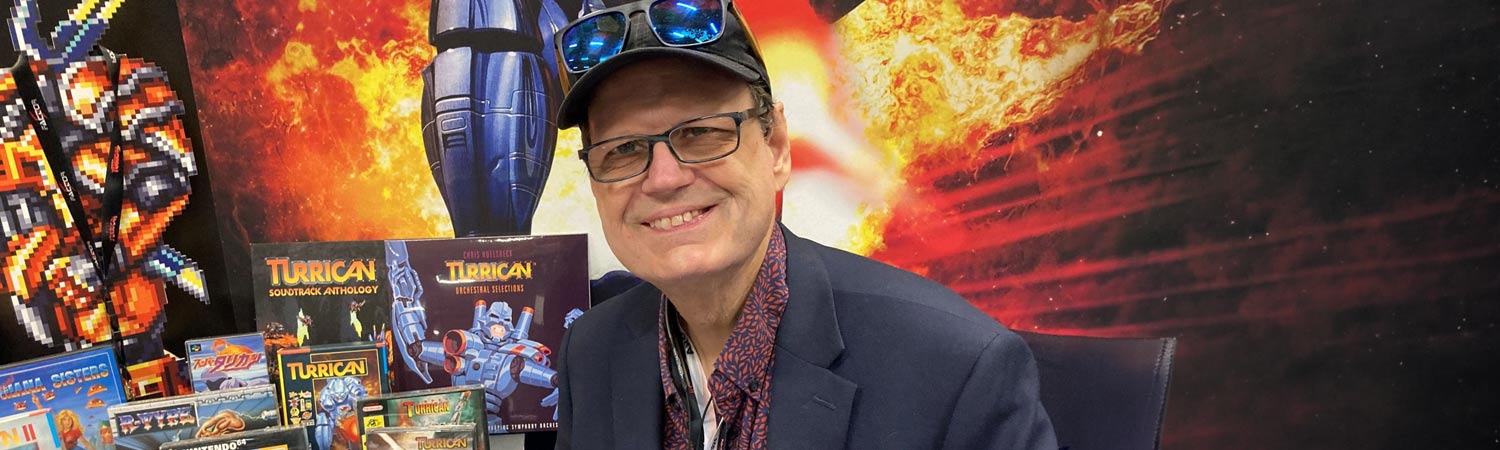
How a teenager from Kassel became one of the most influential composers in the history of computer and video game music
Few names carry as much weight among fans of Commodore 64 and Amiga music as Chris Hülsbeck. Across four decades he composed the scores for some of the most beloved games of the 8-bit and 16-bit eras, built sound tools that shaped the tracker scene itself, and later took his craft into the world of Hollywood-adjacent game production. His story is, in many ways, the story of computer game music growing up alongside the machines that made it possible.
A Teenager, a Magazine Contest, and a Turning Point
Christopher Hülsbeck was born on 2 March 1968 in Kassel, West Germany. He grew up learning piano, and at fourteen he got his hands on a Commodore 64 — the machine that would define the first act of his career. Through school friends who were already dabbling in C64 programming, he picked up assembly language and began experimenting with the machine's SID sound chip.
The real turning point came in February 1986. Hülsbeck heard about a music competition run by the German computer magazine 64'er and spent a single night, from eight in the evening until four in the morning, composing a piece called "Shades." He entered mostly hoping to place in the top ten. Instead, he won first prize outright, along with a cash reward that, for a teenager, was a small fortune. The same magazine also published his music editor, Soundmonitor, as a type-in listing — and it went on to have a significance far beyond a monthly contest.
Soundmonitor and the Roots of the Tracker
Soundmonitor is one of those quiet hinge-points in music software history. Released for the Commodore 64 in 1986, it let musicians enter notes on a scrolling, note-by-note grid rather than fiddling directly with SID chip registers. That interface — data rolling vertically as the pattern plays — is widely believed to have influenced Karsten Obarski when he built Ultimate Soundtracker for the Amiga the following year, the program that gave the entire tracker format its name and its now-familiar layout. In other words, before there was a "Soundtracker Museum" to speak of, Hülsbeck had already helped lay one of its cornerstones.
Rainbow Arts and the Golden C64/Amiga Years
Word of Hülsbeck's talent reached Rainbow Arts, a German game publisher, and he was hired after playing a few of his C64 compositions to the company's boss over the phone. He dropped out of his business-focused high school track to join full-time in early 1987. Over the following years he scored a run of games that are still fondly remembered today, including The Great Giana Sisters, Katakis, and Jinks.
With programmer Peter Thierolf, Hülsbeck also co-created TFMX — "The Final Musicsystem eXtended" — a sound driver for the Amiga prized for its efficient use of the machine's custom chip and its rich, layered sound compared to many contemporaries. TFMX became his signature tool for the rest of the Amiga era and is still used by retro composers recreating that sound today.
It was on the Amiga that Hülsbeck's best-known work arrived: the soundtrack to Turrican (1990) and its sequels. Developed by Factor 5 and designed by Manfred Trenz, the Turrican series paired fast, atmospheric run-and-gun action with music that many players remember as vividly as the games themselves. Hülsbeck composed the Amiga, Commodore 64 and MS-DOS versions of the series, while fellow legend Jochen Hippel handled several Atari ST ports — the two composers' parallel work across platforms is itself a well-known piece of demoscene trivia.
Kaiko and a Difficult Chapter
In 1990 and 1991, Hülsbeck co-founded the companies A.U.D.I.O.S.-Entertainment and Kaiko with Thierolf. He has described this period as both his most creative and, ultimately, one of the hardest — a falling-out with his business partner in 1993 left him repaying debts for years afterward. He kept working through the 1990s, founding his own production company and running a composing contest that helped launch other musicians' careers, before a new opportunity changed his trajectory entirely.
Hollywood Calling: Factor 5, Star Wars, and California
In February 1998, Hülsbeck was hired to score Star Wars: Rogue Squadron for the Nintendo 64 — a high-profile jump from European home-computer games to a licensed, big-budget console title. The job brought him to Factor 5's studio, and by 1999 he had relocated to the United States, working from California on further Rogue Squadron sequels and other Factor 5 titles until the studio's California office closed in 2009. He has worked as a freelance composer since.
From Chiptunes to Orchestras
Rather than fading into nostalgia, Hülsbeck's older work found a second life on the concert stage. Selections from Apidya, the Turrican series, and The Great Giana Sisters have been performed by full orchestras at events including the Symphonic Game Music Concerts in Leipzig and a dedicated tribute show, Symphonic Shades, performed by Germany's WDR Radio Orchestra and choir in 2008. His music has since been played by orchestras as far afield as Stockholm.
In the 2010s, Hülsbeck turned to crowdfunding to keep expanding this legacy, launching a series of Kickstarter campaigns — the Turrican Soundtrack Anthology, an orchestral Turrican II album, and Turrican – Orchestral Selections among them — that brought fans directly into funding new arrangements of his most-loved scores. One bonus project, Turrican – Rise of the Machine (2018), took the opposite approach entirely: composed on his original Amiga TFMX system and recorded on real vintage hardware, it imagines what a fourth Turrican soundtrack might have sounded like had it been made in 1994.
Hülsbeck has continued composing into the 2020s, scoring games such as Tiny Thor (2023), Interstellar Sentinel (2024), and X-Out: Resurfaced (2025) — proof that the composer who helped define the sound of 1980s home computers is still very much an active voice in game music today.
Why He Matters to Tracker History
Hülsbeck's career threads through nearly every chapter this museum covers: a chip-music tool that helped shape the tracker format itself, a defining Amiga-era soundtrack catalogue, a custom music-driver system built from scratch, and a decades-long second act that has kept 8-bit and 16-bit game music alive for new audiences. Few composers connect the earliest days of the Soundtracker to the present quite so directly.
Further reading
- Chris Huelsbeck — Wikipedia
- Chris Hülsbeck — Video Game Music Preservation Foundation Wiki
- Turrican Soundtrack Anthology — Chris Huelsbeck Productions
- Turrican – Rise Of The Machine — Bandcamp
- Jochen Hippel — Wikipedia (for the parallel Atari ST Turrican scores)