How Sound Chips Work: Inside the YM2149 and the MOS 6581 SID
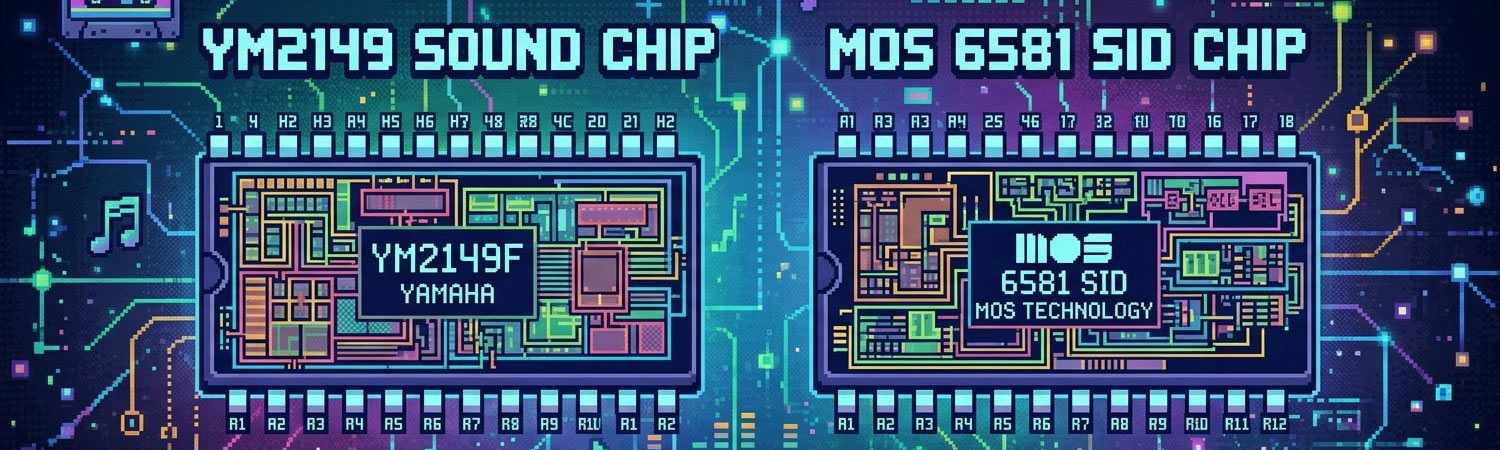
Long before samplers and streaming audio, home computers and arcade machines made music and noise with tiny dedicated pieces of silicon called sound chips, or more formally programmable sound generators (PSGs). These chips didn't play back digital recordings — there was no memory or bandwidth for that in the late 1970s and early 1980s. Instead, they generated sound algorithmically, in real time, from a handful of numbers written into their registers by the host CPU. This article explains the general principles behind how a sound chip creates sound, then goes deep on two of the most famous and most-loved chips in computing history: Yamaha's YM2149 and MOS Technology's 6581 SID.

1. The Basic Idea: Turning Numbers Into Sound
Sound is a vibration — a rapidly changing air pressure wave that your eardrum picks up. An electronic sound chip's job is to produce a rapidly changing voltage that, once amplified and sent to a speaker, recreates that pressure wave. Everything a sound chip does boils down to three building blocks:
- Oscillators — circuits that repeat a waveform (square, triangle, sawtooth, noise…) at a controllable frequency. The frequency determines the pitch you hear.
- Amplitude / envelope control — circuits that control how loud the waveform is at any given instant, which is what makes a note sound like a plucked string, a organ drone, or a percussive hit.
- Mixing and output stage — circuitry that combines multiple oscillators, and a digital-to-analog converter (DAC) that turns the internal digital/stepped values into a continuous analog voltage that can drive a speaker or amplifier.
A CPU "talks" to the sound chip through a small set of registers — addressable memory cells inside the chip. Writing a number to a "frequency register" changes the pitch; writing to a "volume register" changes the loudness; and so on. A game or piece of music software is, in effect, just a program that writes a stream of these numbers into the chip's registers many times per second, in time with the music.
Square waves: the simplest useful waveform
The cheapest waveform to generate digitally is a square wave: a signal that simply flips between two voltage levels (high and low) at a set rate. Electronically this can be built from a counter that counts down from a programmed value and toggles an output bit every time it reaches zero, then reloads. Because it is so cheap to build many of these counters side by side, early sound chips like the YM2149 use square-wave oscillators as their core building block, with 3 independent channels being a very common design choice — enough to play a bassline, a chord note and a melody at the same time.
A pure square wave sounds harsh and "buzzy" to the ear because — mathematically, by Fourier analysis — a square wave is made up of a fundamental tone plus a whole staircase of odd-numbered harmonics. This is exactly the raw, slightly nasal tone that people associate with 8-bit "chiptune" music.
2. The Yamaha YM2149 (SSG)

The Yamaha YM2149, marketed by Yamaha as an "SSG" (Software-Controlled Sound Generator), is essentially an improved, lower-power clone of General Instrument's earlier AY-3-8910. It became one of the most widely used sound chips of the 1980s, found in the Atari ST, the Amstrad CPC, many MSX computers, the ZX Spectrum 128, and a huge number of arcade boards.
Internal architecture
The YM2149 is built around three completely independent square-wave (technically "pulse") tone generators, usually called channels A, B and C, plus one shared noise generator and one hardware envelope generator. All of this is controlled through 16 addressable 8-bit registers.
| Register(s) | Function |
|---|---|
| R0–R5 | Fine and coarse tone period for channels A, B, C (12-bit values, two registers per channel) |
| R6 | Noise generator period (5-bit) |
| R7 | Mixer control — enables/disables tone and/or noise per channel |
| R8–R10 | Channel volume (4-bit) or "use the envelope generator instead" flag, per channel |
| R11–R12 | Envelope period (16-bit, fine + coarse) |
| R13 | Envelope shape select |
| R14–R15 | Two general-purpose I/O ports (often used for things unrelated to sound, e.g. joystick or keyboard input) |
How each tone channel actually produces a pitch
Each tone generator contains a 12-bit down-counter clocked from the chip's master clock (commonly around 1–2 MHz). Every time the counter reaches zero it toggles the channel's square-wave output and reloads itself from the 12-bit period value written into that channel's two registers. A smaller period number means the counter reaches zero faster, so the output toggles more often — producing a higher pitch. The relationship is roughly:
output frequency = master_clock / (16 * period_value)
This is a classic example of frequency division synthesis: rather than generating an arbitrary sine wave, the chip derives musical pitches by dividing down a single fast master clock by different integer amounts.
The noise generator
Alongside the three tone channels sits a single noise generator, built from a linear-feedback shift register (LFSR) clocked at a programmable rate. An LFSR produces a long, non-repeating (over any practical timescale) sequence of pseudo-random bits, which sounds like static or hiss when fed to the output. Register R7 lets the programmer route this shared noise source into any combination of the three channels — mixed together with, or instead of, that channel's tone. This is how the chip fakes drums, explosions, wind, and other percussive or textural effects, despite having no dedicated percussion hardware at all.
Volume and the hardware envelope
Each channel normally just has a fixed 4-bit (16-step) volume, giving fairly coarse loudness control. But any channel can instead be switched to follow a single shared hardware envelope generator: a counter driven by its own programmable period (R11/R12) that walks through one of several fixed shapes selected by R13 — for example a one-shot decay, a repeating sawtooth, or a triangle that ramps up and down forever. Because only one envelope generator exists for the whole chip, composers had to be creative if they wanted more than one independently-shaped envelope at a time — often by rewriting the plain 4-bit volume register very rapidly from software instead, a trick commonly called "software envelopes" or amplitude/frequency modulation tricks in the demoscene.
More technical detail on the register layout and its subtle differences from the AY-3-8910 can be found in this write-up of the YM2149 datasheet (PDF, grauw.nl).
3. The MOS Technology 6581 SID

The MOS Technology 6581, universally known as the SID ("Sound Interface Device"), powered the Commodore 64 and is widely regarded as the most advanced sound chip of its generation. Rather than being a simple square-wave generator like the YM2149, it was designed from the start as a genuine miniature subtractive synthesizer on a single chip, complete with multiple waveforms per voice, per-voice envelopes, and an analog filter. It was designed by engineer Bob Yannes, who later co-founded synthesizer company Ensoniq.
Three voices, four waveforms each
The SID has three independent oscillator/voice sections. Each voice can generate not just a square wave but four selectable waveform types, which can even be combined:
- Triangle — soft, smooth, few harmonics; good for flute or bell-like tones.
- Sawtooth — buzzy, rich in both odd and even harmonics; classic "synth brass/strings" tone.
- Pulse (variable-width square) — unlike the fixed 50% square wave of simpler chips, the SID lets you continuously vary the pulse width, which changes its timbre — a technique called pulse-width modulation (PWM), capable of a "fatter", chorus-like sound when swept over time.
- Noise — generated by a 23-bit LFSR, used for percussion, wind, and sound effects.
The ADSR envelope generator — one per voice
Unlike the YM2149's single shared hardware envelope, every one of the SID's three voices has its own independent ADSR envelope generator (Attack, Decay, Sustain, Release). Each of the four stages is independently programmable:
- Attack — how quickly volume rises from zero to full when a note starts.
- Decay — how quickly volume then falls from full to the sustain level.
- Sustain — the constant level held while a key/note is held down.
- Release — how quickly volume falls to zero once the note is released.
This alone lets the SID imitate the natural volume shape of real instruments — a plucked string's fast attack and slow decay, an organ's near-instant attack and flat sustain, a bowed string's slow swell — far more convincingly than a chip with just a fixed on/off volume.
Ring modulation and hard sync
Each voice's oscillator can also be modulated by its neighbor, enabling two distinctive analog-synth techniques:
- Ring modulation — multiplies one voice's triangle waveform by another voice's frequency, producing clangorous, bell-like or metallic inharmonic tones — famously used for the SID's convincing bell and gong sounds.
- Hard sync — forces one oscillator to restart its cycle every time a neighboring oscillator restarts its own, locking their phases together and producing bright, harmonically complex, sweep-able tones often used for "screaming" synth-lead effects.
The analog multi-mode filter
Perhaps the single most distinctive part of the SID's design is that, after the three digital oscillators generate their waveforms, the signal passes through a genuinely analog resonant filter built directly on the chip, with programmable cutoff frequency and resonance. The filter can be switched between low-pass, high-pass, and band-pass modes (or combinations of them), and each voice can be individually routed into or around the filter. Because the filter is analog rather than calculated in the digital domain, it has a warm, slightly unpredictable, characterful sound — and because the 6581 and its 8580 successor used somewhat different manufacturing processes, the two revisions of the SID are famous for sounding subtly different from one another, something collectors and musicians still debate today.
Why the SID still has a cult following
The combination of multiple waveforms, independent ADSR envelopes, oscillator modulation and a resonant analog filter made the SID capable of a much wider timbral palette than most contemporaries, which is why it is credited with helping to kick off the demoscene and why musicians still write new music for real SID chips today, using modern tools and even dedicated USB SID players.
4. Side by Side: YM2149 vs. SID 6581
| Yamaha YM2149 | MOS 6581 SID | |
|---|---|---|
| Voices | 3 tone + 1 shared noise | 3 fully independent voices |
| Waveforms per voice | Square/pulse only (fixed 50% duty) | Triangle, sawtooth, variable pulse, noise |
| Envelope | One shared hardware envelope for the whole chip | One independent ADSR per voice |
| Filter | >None | Analog multi-mode resonant filter |
| Special tricks | Noise mixed into any channel | Ring modulation, hard sync, pulse-width modulation |
| Famous home | Atari ST, Amstrad CPC, MSX, arcade boards | Commodore 64 / 128 |
Broadly, the YM2149 favors simplicity and low cost, producing its characteristic bright, buzzy chip tone very efficiently, while the SID trades extra silicon complexity for genuine synthesizer-style sound shaping — which is exactly why C64 music from the 1980s can still sound surprisingly expressive and "musical" compared to many of its contemporaries.
Further Reading
- Wikipedia: Yamaha YM2149
- Wikipedia: General Instrument AY-3-8910 (the chip the YM2149 is based on)
- Yamaha YM2149 datasheet (PDF)
- Wikipedia: MOS Technology 6581 (SID)
- Wikipedia: ADSR envelope
- Wikipedia: Demoscene
- Wikipedia: Programmable sound generator
- C64-Wiki: SID — deep technical reference on the SID's registers