The History of the SID Chip
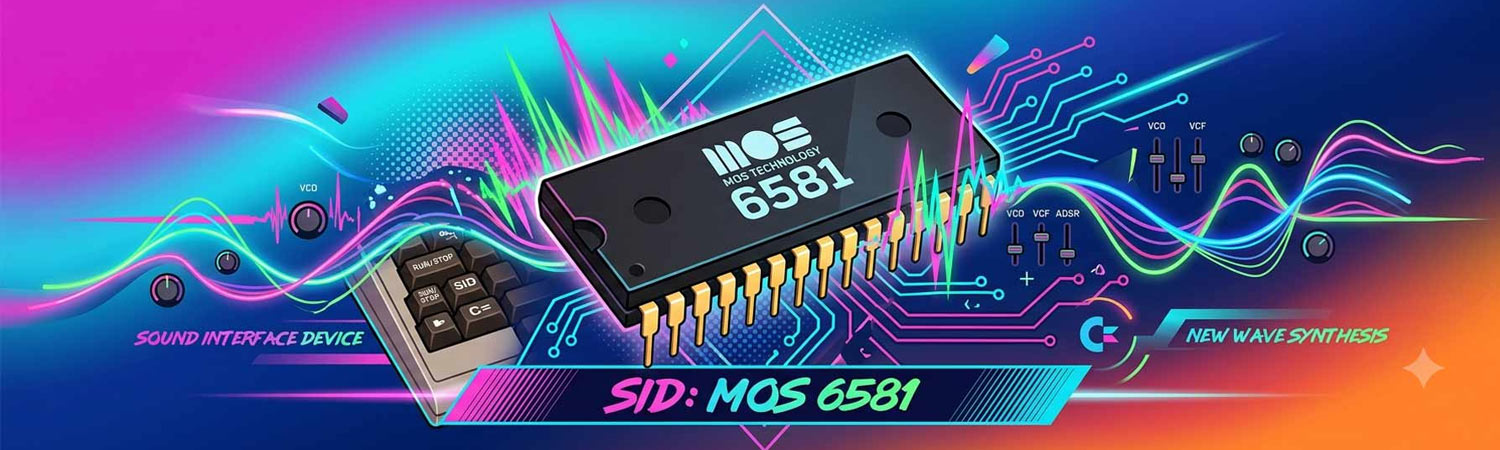
How the Commodore 64's sound chip became a musical instrument in its own right
Most sound chips from the early 1980s were built to make beeps and simple effects for games. The Commodore 64's SID chip, short for Sound Interface Device, was built to be something closer to a synthesizer. That single design decision is why, more than forty years later, people are still writing new music for it.

Origins: A Synthesizer Designer Joins Commodore
The SID chip was designed by engineer Bob Yannes, who worked at MOS Technology, the chip-making subsidiary of Commodore. Yannes had a background in synthesizer design and was unimpressed by the sound chips used in competing computers at the time, including those from Atari, feeling they had clearly been designed by people with no background in music. Wanting to build a genuine instrument rather than another simple beeper chip, he gave the SID features borrowed directly from the synthesizer world, such as envelope controls and adjustable filters, that were unheard of in other home computer sound hardware of the era.
Yannes led a small team, made up of himself, two technicians, and a CAD operator, who designed and completed the chip in about five months during the second half of 1981. Time pressure meant not everything on his wish list made it into the final design; he later estimated that only about three quarters of his planned feature list survived. An ambitious plan for 32 independently addressable voices sharing a single oscillator, for example, had to be dropped in favor of a simpler approach: the same working oscillator circuit was simply copied three times across the chip, giving the SID its three separate voices.
Inside the Chip
The finished SID offered three audio oscillators, each capable of producing a triangle wave, sawtooth wave, pulse wave, or noise, with the ability to combine several of these waveforms on a single voice for more complex tones. Each voice had its own attack/decay/sustain/release envelope, the same kind of volume shaping found in dedicated synthesizers. All three voices could be routed through a shared, adjustable analog filter that supported low-pass, high-pass, and band-pass modes, giving composers a way to sculpt harsh digital waveforms into warmer or more aggressive tones.
The SID also supported ring modulation and oscillator sync between voices, both effects borrowed from analog synthesizers, letting musicians create metallic, bell-like, or otherwise unusual sounds that went well beyond simple beeps. Because of imperfections in the chip's manufacturing, the SID also had a quirky side effect: rapidly adjusting its main volume register produced an audible click that clever programmers learned to exploit, effectively turning it into a crude fourth channel capable of playing back digitized sound samples.

6581 and 8580: Two Personalities
The chip shipped with the original Commodore 64 in 1982 as the 6581. It ran on an older manufacturing process, needed a higher operating voltage, and was notably sensitive to static discharge, which is why so many original 6581 chips have since died or developed faulty filters. Its filter behavior also varied significantly from one individual chip to another, giving early Commodore 64 music its famously unpredictable, slightly distorted character.
Around 1986, a revised version called the 8580 took over, first in the Commodore 128 and later in newer Commodore 64 models. Built using a more modern manufacturing process, it ran cooler, was more durable, and had a cleaner, more consistent filter that matched the chip's original specification more closely. Ironically, many musicians and collectors have come to prefer the "flawed" 6581 specifically because of its distortion and unpredictability, treating those quirks as part of the SID's character rather than as defects to be corrected.
A Chip Built for Music, Used by Musicians
Because the SID behaved so much like a real instrument, a wave of composers built entire careers around learning its quirks and pushing past its official specifications. Rob Hubbard became known for dense, layered arrangements on titles like Commando and International Karate. Martin Galway developed a reputation for smooth, singing melodic lines on games including Wizball and Arkanoid. Other prominent SID composers included David Whittaker, Jeroen Tel, Ben Daglish, and Chris Hulsbeck, each finding their own way of working around the chip's three-voice limit to create music that sounded far richer than the hardware should have allowed.
The technical demands of programming the SID directly, often bypassing Commodore's own documentation in favor of self-discovered tricks, meant that composing music for the Commodore 64 was as much a programming discipline as a musical one. That culture of shared technical discovery became closely tied to the wider Commodore 64 demoscene, where programmers and musicians competed to show off ever more inventive uses of the machine's graphics and sound hardware.
Life After the Commodore 64
Production of the original SID chips ended in the early 1990s as Commodore's fortunes declined, and unused chips have since become collectible. Rather than disappearing, though, the SID found a second life through emulation and hardware preservation projects. Software emulators such as reSID were built to reproduce the chip's exact filter behavior in code, forming the basis of tools still used today to play back old Commodore 64 music. On the hardware side, projects like the HardSID sound card and, later, the Elektron SidStation synthesizer, kept real SID chips in active musical use long after the C64 itself had faded from shop shelves.
Bob Yannes himself left Commodore in 1983 and went on to co-found Ensoniq, a company that built digital synthesizers and samplers, carrying his interest in music technology forward well beyond his work on the SID.
Legacy
The SID chip is widely regarded as one of the most advanced pieces of sound hardware of its era, and is often credited as a key reason the Commodore 64 became the best-selling home computer of all time. Its influence reaches well past the C64 itself: the chiptune music genre owes much of its identity to composers who learned to treat the SID's limitations as creative tools rather than obstacles. Decades after the chip stopped being manufactured, thousands of new SID tunes are still being composed, and the chip continues to be studied, emulated, and collected by musicians and retro computing enthusiasts alike.
Further Reading & Listening
- MOS Technology 6581 – Wikipedia: full technical history and specifications
- IEEE Spectrum – Chip Hall of Fame: MOS Technology 6581: on the chip's engineering legacy
- C64-Wiki – SID: technical reference and register details
- High Voltage SID Collection (HVSC): the largest archive of Commodore 64 music
- DeepSID: an in-browser SID player for exploring the archive
- "Loops and Bloops": Music of the Commodore 64 Games: an academic look at C64 game music culture