History of Chiptune music
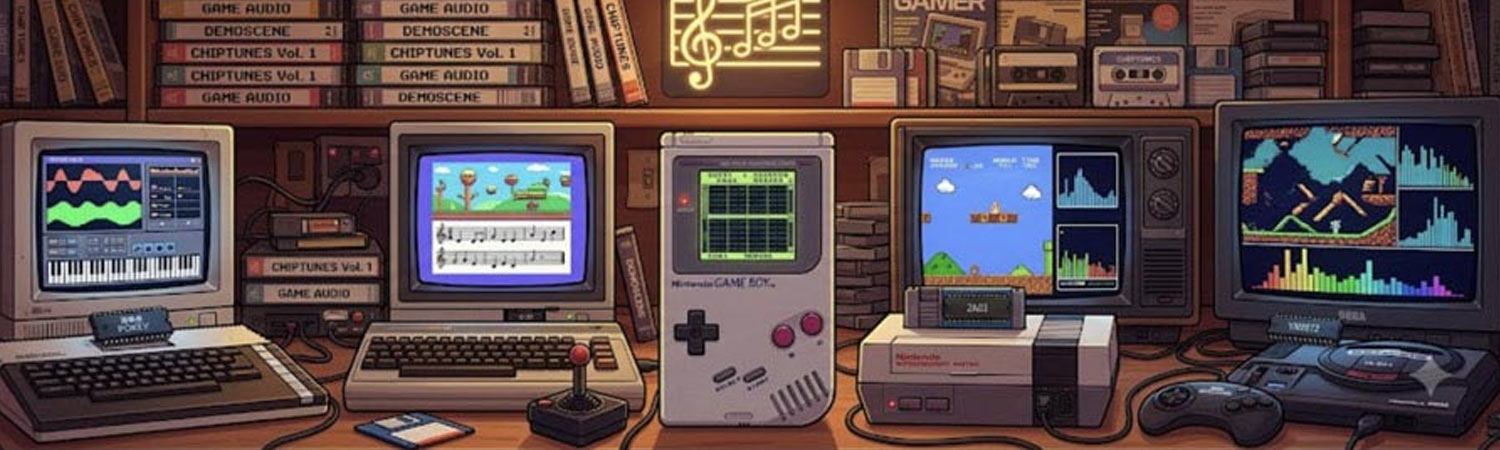
Chiptune is one of the rare music genres whose name describes its own technical limitation: music made on the literal sound-generating chips of old computers and game consoles. What started as an engineering workaround — squeezing any sound at all out of underpowered hardware — eventually became an aesthetic choice, then a genre, then a global subculture with its own stars, labels, and festival stages.
Before It Had a Name: Arcade Beginnings
Chiptune's roots stretch back to the golden age of arcade games, when sound was a side effect of repurposed circuitry rather than a deliberate art form. Tomohiro Nishikado's Gun Fight (1975) is often cited as containing one of the earliest game opening tunes, and his Space Invaders (1978) introduced something more influential: a simple four-note descending bassline that sped up as enemies advanced, making music react to gameplay for the first time. Namco's Rally-X (1980) is generally credited as the first game with continuous, genuinely melodic background music, and that same year Stratovox became the first game to attempt speech synthesis. None of this was "chiptune" yet — there was no scene, no name, no aesthetic intention — but it established the idea that a simple chip could carry a tune.
The Home Computer and Console Era
Through the early-to-mid 1980s, dedicated sound chips turned game and computer composers into genuine musicians. In Japan, NEC's PC-88 and PC-98 computers used Music Macro Language (MML) and early FM synthesis boards, giving composers like Yuzo Koshiro a "warm" tonal palette he'd keep using — by choice, not necessity — for decades, on games such as Streets of Rage. In the West, the Commodore 64's MOS 6581 SID chip became the genre's first true icon: three voices, four waveforms, and an analog multimode filter gave composers like Rob Hubbard, Ben Daglish, and Martin Galway enough expressive range to write music that's still studied and remixed today. Around the same time, on the demoscene side of things, programmers began reverse-engineering and reusing each other's player routines — in 1986, the demoscene musician Jeroen "Red" Kimmel famously studied Rob Hubbard's own playback code before writing one of his own — laying early groundwork for a culture of shared, hackable music tools.
Where the Word Came From
The term "chiptune" itself is tied directly to a specific piece of software: the Commodore Amiga. Unlike the SID-driven C64, the Amiga's Paula chip played back actual audio samples rather than synthesizing waveforms in real time — and in 1987, German programmer Karsten Obarski released Ultimate Soundtracker, a music-composing tool directly inspired by a C64 program he'd used and liked, Chris Hülsbeck's Soundmonitor. Obarski simplified Soundmonitor's layout into a single 64-step grid split into four scrolling columns — melody, accompaniment, bass, and percussion — creating the now-universal "pattern" view, and bundled samples and pattern data together into a new file format he called the module. The workflow it introduced gave the entire category of software its name: the tracker.
Ultimate Soundtracker was a commercial flop, but the demoscene didn't care about that — it disassembled the program, fixed its bugs, and ran with the idea. Pex "Mahoney" Tufvesson and Anders "Kaktus" Berkeman released the cleaned-up NoiseTracker in 1989; ProTracker followed in 1990 and became the dominant Amiga tracker for years. Because trackers used tiny looped samples to mimic the punchy, synthetic sound of older sound chips like the SID, that specific style of music — made with sample-based tools but sounding like the chip-synthesized music that came before it — picked up the nickname "chiptunes," referencing the Amiga's "chip memory," the small pool of fast RAM its custom chips could access. The earliest tunes specifically remembered as chiptunes in this sense are generally credited to scene musicians like 4-Mat, Baroque, TDK, Turtle, and Duz, working around 1989–1990.
The Demoscene Becomes Chiptune's Home
As the video game industry moved toward CD-ROM audio in the 1990s — first on consoles like the PlayStation, which could simply stream studio recordings instead of synthesizing music in real time — chip-restricted composition stopped being a commercial necessity. Composers like Mark Knight (of the Amiga group TDK), who scored Wing Commander, later argued that this shift "killed" a distinct sound: suddenly game music could sound like anything, which meant it increasingly sounded like everything else. As the games industry's need for chip music faded, the demoscene became its main refuge — a place where musicians kept composing for the SID, the YM2149, the Amiga, and eventually emulated or repurposed game consoles, not because the hardware demanded it, but because they wanted to.
A Genre of Its Own
By the 2000s, chiptune had outgrown the demoscene and become a recognizable genre in its own right, helped along by two very portable, very hackable pieces of hardware: the Game Boy, running tools like Little Sound Dj (LSDJ) and Nanoloop, and the NES/Famicom, composed for using tools like FamiTracker. A new generation of artists released music as standalone tracks and albums rather than game or demo soundtracks, distributing them through netlabels such as 8bitpeoples, 8bitcollective, and micromusic.net. Names associated with this wave include Nullsleep and Bit Shifter (both linked to 8bitpeoples), Trash80, Sabrepulse, goto80, Chipzel, and Anamanaguchi, who became one of the few chip-rooted acts to cross over into mainstream rock and pop touring. Some artists, like YMCK, added vocals to chiptune for the first time in a meaningful way; others, like Alex Mauer, even pressed original chip music onto real NES cartridges.
Chiptune Today
Chiptune's influence has spread well beyond its original hardware. Modern games such as Shovel Knight and Undertale deliberately use chiptune or chiptune-adjacent scoring as a stylistic choice rather than a technical limit, and mainstream producers — from dubstep artists drawing on Yuzo Koshiro's work to complextro pioneer Porter Robinson — have cited chip sounds as a direct influence. The scene also has its own live culture: events like the United States' MAGFest run a dedicated "Chipspace" venue and mainstage "Chip Rave" show, while chiptune acts regularly perform using real, modified vintage hardware — Game Boys, NES consoles, SID chips on stage — alongside laptops running modern tracker-style software.
What began as Tomohiro Nishikado coaxing a tune out of arcade circuitry, and was later named after a few kilobytes of Amiga memory, has become a genre that musicians now choose deliberately — proof that a self-imposed limitation, once mastered, can turn into a sound nobody wants to give up.
Curious to hear the evolution for yourself? The High Voltage SID Collection, the Amiga Music Preservation project, and the SNDH Archive each preserve thousands of original tunes from the platforms that started it all.