Aleksi Eeben. Finnish composer, sound designer, and demoscene pioneer known as "Heatbeat"

Finnish composer, sound designer, and demoscene pioneer known as "Heatbeat"
- Born: Antti Aleksi Mikkonen, 2 July 1976, Finland
- Aliases: Heatbeat, Please Annihilate Oulu
- Genres: Chiptune, electronica, ambient, jazz, video game music
- Active since: 1988–present
- Labels: Monotonik, Kahvi
Early Life and First Steps into Computing
Aleksi Eeben grew up in Finland with an early fascination for both music and computers. As a child he experimented with rhythm and singing, picked up simple programming tutorials from computer magazines, and began writing his own code in BASIC on the VIC-20 and later the Commodore 64. This mix of curiosity for sound and machinery would come to define his entire career: he didn't just want to make music, he wanted to build the tools to make it with.
Joining the Demoscene
In 1990, still a teenager, Eeben joined the demoscene group Rebels, one of the many collectives producing "demos" — real-time audiovisual programs made to show off programming and artistic skill on home computers like the Commodore 64 and Amiga. He soon founded his own group, Carillon, which eventually merged with another group, Cyberiad, to form CNCD, a name that remained active in the scene for decades afterward.
Working under the alias Heatbeat, Eeben became one of the most recognizable composers of the Amiga and Commodore 64 demoscene, producing hundreds of tracker modules for demos and music competitions. His style blended the technical constraints of chip music with surprisingly rich melodic and jazz-influenced ideas, something that set him apart from many of his contemporaries.
From Demos to Games
Eeben's talents didn't stay confined to the demoscene. In 1994 he composed the soundtrack for the Amiga game Elfmania. Years later, in 2001, he teamed up with fellow demoscene musician Jonne Valtonen (known as Purple Motion) to score the Game Boy Color title Project S-11, using a custom tracker built specifically for the game. The soundtrack is still cited by retro-gaming critics as one of the most technically ambitious pieces of music ever produced on the original Game Boy hardware.
He went on to contribute music to several other titles, including Tom and Jerry: Mouse Hunt, the homebrew game Mean Mr. Mustard, and the Game Boy Advance pinball title Hardcore Pinball.
The Tool Builder
What makes Eeben unusual even among demoscene musicians is how much of his time went into building the software other musicians would use. Frustrated with the clunky music tools available for the Commodore 64, he wrote his own tracker called John Player, followed by Polly Tracker in 2004, a four-channel MOD tracker for the C64. In 2006 he released Sid Vicious, a software emulator of the C64's iconic SID sound chip, adapted to run on the far more limited VIC-20.
He continued this tradition well into the 2020s. In 2022, supported by a grant from the Arts Promotion Centre Finland, he released Carina, a monophonic synthesizer for the original Game Boy. He also maintains a public archive of his 8-bit software and tools called Aleksi's Eight Bit Shed, preserving decades of homemade music technology for other creators to use and study.
A Decade at Nokia
In 2002, Eeben joined Nokia as a principal sound designer, a job he held until 2015 (the company having become Microsoft Mobile along the way). There he composed ringtones, alerts, and system sounds heard on millions of phones worldwide, and worked on sound banks and audio branding for the company's devices.
Later in his time at Nokia he became creative director for the ringtone sets used on Lumia phones, a project that involved recording material with the Bratislava Symphony Orchestra. He also helped release Nokia Tones, a Windows Phone app collecting a thousand classic Nokia ringtones — bringing his demoscene sensibility for nostalgia and craftsmanship into a mainstream consumer product.
Solo Albums and Ongoing Work
Alongside his commercial and demoscene work, Eeben has built a substantial catalogue of solo albums, many of them chiptune-based collections of SID or MOD compositions released through the net labels Monotonik and Kahvi. His debut EP, Please Annihilate Oulu, appeared in 2000, followed by releases such as Music Box, The White Box, Spaceman Far Away From Home, and Fruits For Druids & Vines For Valkyries. His music today is self-published on Bandcamp.
Interestingly, music runs in the family: his younger brother, Konsta Mikkonen, is also a demoscene musician and dance producer, known under the alias Muffler.
Current Work: Heartbeat Soundtracker
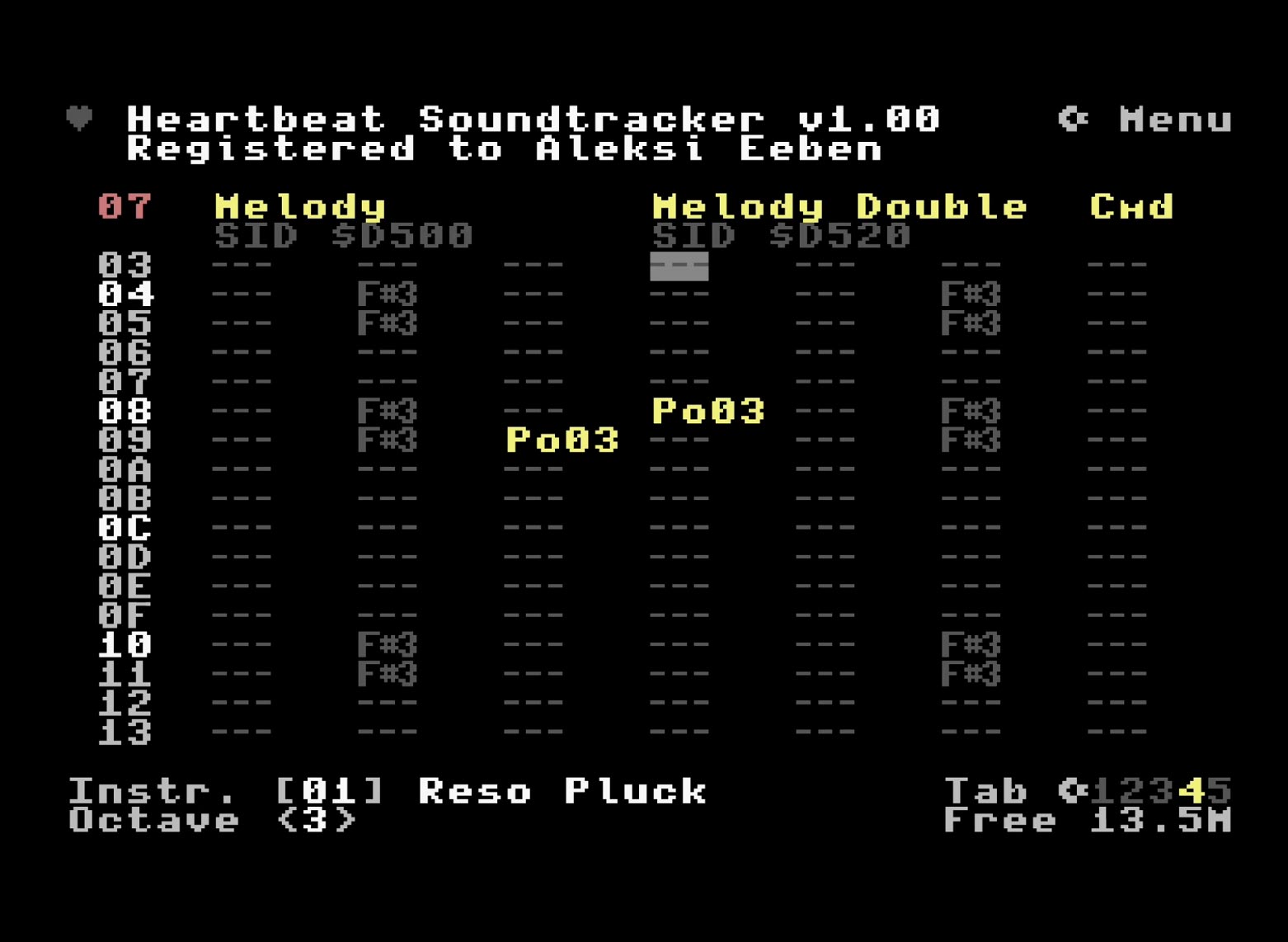
Eeben's habit of building his own instruments hasn't slowed down. As of 2026 he is working on Heartbeat Soundtracker, a new music tracker built for the C64 Ultimate — a modern FPGA-based reincarnation of the Commodore 64. Progress updates posted on his X (Twitter) account describe an ambitious scope: up to 31 simultaneous channels, combining 8 emulated SID chips with 16-bit sample playback over the Ultimate Audio channels, fast file loading through Ultimate DOS, and a detailed pattern editor with cut/copy/paste, track replication, and per-track labeling.
He has shared early demonstrations of the tracker in action, including a cover of the Knight Rider theme used as a first public test of the software. The project is still marked "work in progress," continuing the same do-it-yourself spirit that has driven his tools since the John Player and Polly Tracker days on the original C64.
Legacy
Aleksi Eeben's career traces a rare arc from bedroom coder to celebrated demoscene composer to professional sound designer at a global electronics company — all while never fully stepping away from the scene that shaped him. His combination of musical craft and homemade software tools has made him one of the more quietly influential figures in chiptune and demoscene history, someone as respected for the instruments he built as for the music he played on them.
Read More
- Wikipedia: Aleksi Eeben
- Demozoo profile
- Legacy Portable Computing Wiki
- Aleksi Eeben's official website
- Aleksi Eeben on YouTube
- Aleksi Eeben on X — Heartbeat Soundtracker progress updates
- Listen: Spaceman Far Away From Home (Internet Archive)