The gravis ultrasound phenomenon
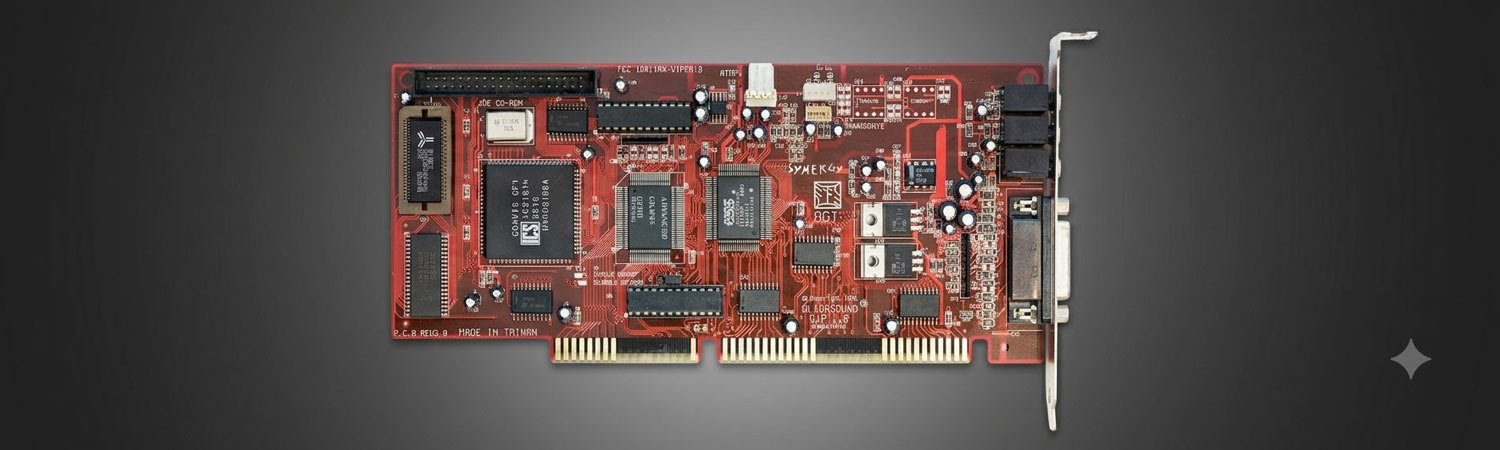
In the mid-1990s, the IBM PC audio landscape was thoroughly dominated by Creative Labs and their ubiquitous Sound Blaster series. If you were a casual gamer, a Sound Blaster was the default choice. But if you were a demoscener, a tracking musician, or an audio purist, there was only one piece of silicon that mattered: the Advanced Gravis Ultrasound, affectionately known as the GUS.
Released in 1992 by Canadian joystick manufacturer Advanced Gravis, the Ultrasound became an overnight legend. It didn’t achieve this status by conquering the retail market—in fact, it was notoriously plagued by compatibility issues with mainstream DOS games. Instead, the GUS built a fierce, fanatical cult following because it was mechanically built for music tracking.
The Sound Blaster Limitation vs. The GUS Solution
To understand why tracking musicians fell in love with the GUS, you have to understand the technical limitations of standard PC audio at the time.
A standard Sound Blaster 16 featured an onboard chip that relied heavily on the computer’s central processor (the CPU). If you wanted to play a tracker module (like an .XM or .S3M file) with 16 separate audio channels, your 486 computer had to manually mix those 16 audio streams down into a single stereo channel in real-time, using software. This ate up massive amounts of CPU cycles, leaving very little horsepower to spare for smooth graphics or complex game logic.
The Gravis Ultrasound threw that paradigm out the window by utilizing a dedicated GF1 hardware chip.
Hardware Mixing: True Sonic Independence
Instead of relying on the CPU, the Ultrasound performed hardware mixing. It could handle up to 32 independent hardware channels simultaneously without breaking a sweat. It didn't care if a song had 4 channels or 24; the GF1 chip mixed the tracks completely on-board.
Dedicated RAM
The real killer feature was that the GUS came equipped with its own onboard RAM (expandable up to 1 Megabyte). Tracker musicians could upload their audio samples—the drum hits, the synth loops, the basslines—directly onto the sound card's memory. When a tracker program triggered a note, the card played it directly out of its own memory bank, bypassing the slow system bus entirely.
The Anthem of the Demoscene
Because of this unique hardware architecture, the Gravis Ultrasound became the official engine of the demoscene—the underground global subculture of programmers, artists, and musicians pushing computer hardware to its absolute mathematical limit.
If you wanted to run the era's bleeding-edge 3D real-time graphical demos, you couldn't afford to waste 20% to 30% of your CPU power just processing the chiptune background music. The GUS allowed demogroups to pack orchestral, studio-grade tracker music into their demos with effectively 0% CPU overhead.
Realizing the power of this niche, Gravis did something brilliant: they actively supported the underground. They distributed free SDKs, sponsored demoscene parties (like Assembly and The Party), and gave hardware directly to the software coders writing the legendary trackers of the era.
As a direct result, iconic software like Scream Tracker 3, FastTracker II, and Impulse Tracker featured flawless, native hardware support for the Ultrasound.
| Feature / Spec | Creative Sound Blaster 16 | Advanced Gravis Ultrasound (GUS) |
|---|---|---|
| Primary Synthesis Method | FM Synthesis (Yamaha OPL3) | Wavetable Synthesis (PCM Samples) |
| Onboard Audio RAM | None (Uses system memory/CPU streaming) | 256 KB (Expandable up to 1 MB) |
| Hardware Voice Channels | 0 (Relies on CPU for multi-channel mixing) | Up to 32 hardware mixed independent channels |
| CPU Overhead (Music Trackers) | High (Takes 15-30% CPU to mix channels) | Near 0% (Handled entirely by GF1 chip) |
| Audio Playback Quality | Often prone to background hiss/noise lines | Crisp, independent 16-bit studio playback |
| 1990s DOS Gaming Compatibility | Universal (Industry Standard) | Poor/Flawed (Required finicky software emulators) |
Why the Revolution Ended
If the Ultrasound was vastly superior for digital audio playback, why didn’t it win the sound card wars?
The answer comes down to two fatal flaws: AdLib compatibility and marketing muscle. Most early PC games were programmed strictly for the Sound Blaster’s FM synthesis architecture. To run these games on a GUS, users had to run finicky software emulation drivers that frequently crashed or sounded inaccurate. For the average consumer who just wanted to play DOOM out of the box without configuring a messy DOS configuration file, the Sound Blaster won on pure convenience.
By the time Windows 95 arrived, computer CPUs became fast enough that software mixing ceased to be a bottleneck. The architectural advantages of the GF1 chip faded as host processing power took over.
The Legacy
Advanced Gravis eventually exited the sound card market, but the Ultrasound's place in digital music history is permanent. It bridged the gap between the chip-tune bleeps of the 1980s and the high-fidelity streaming audio of the late 90s. For a glorious, chaotic window of time, the GUS gave teenage bedroom bedroom producers the power of a digital audio workstation years before the rest of the world caught up—cementing its crimson circuit board as a holy relic of the tracking museum.