FastTracker & FastTracker 2: How a Swedish Demogroup Brought the Demoscene to the PC
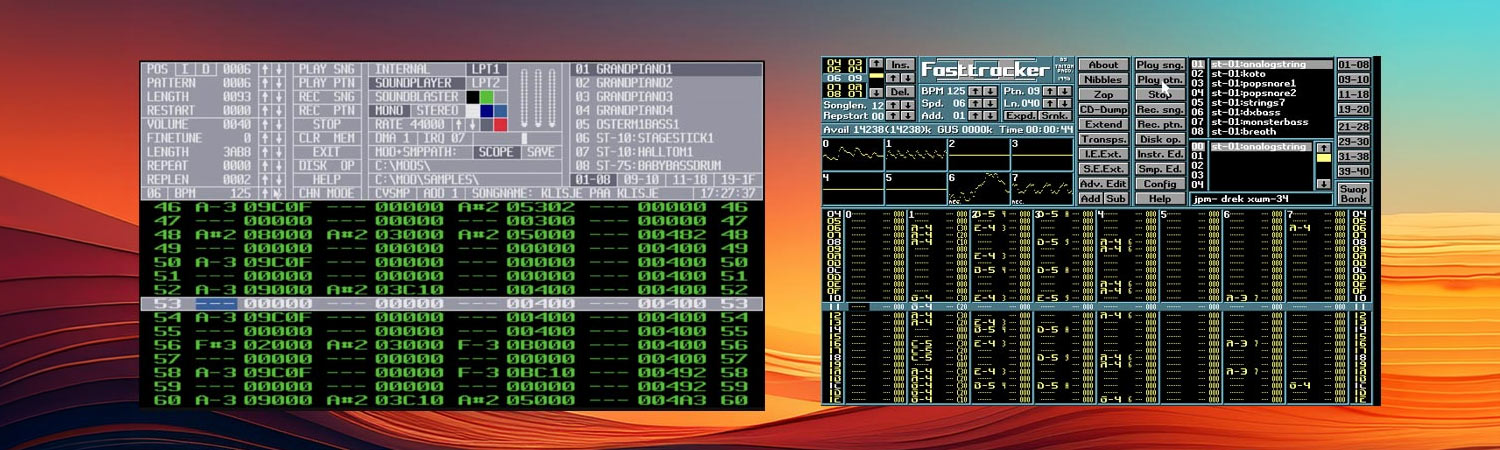
In the early 1990s, if you wanted to make serious computer music with real instruments, you owned a Commodore Amiga. Its custom Paula sound chip and Karsten Obarski's Ultimate Soundtracker, later refined into ProTracker, had already invented an entire genre of software: the music tracker, a sequencer that arranges digital samples on a vertical grid of rows and channels instead of a musical staff. The IBM PC, by comparison, was a music production joke — most machines could only beep through a tiny internal speaker or squawk through a basic FM synthesis card. Yet by the mid-1990s, the balance of power in the demoscene had flipped almost completely toward the PC. The single biggest reason for that shift was a small, humble piece of DOS software called FastTracker, and its far more famous successor, FastTracker 2.
1. Before FastTracker: the Amiga's head start
The Amiga's tracker scene had a multi-year lead on the PC. ProTracker let musicians arrange four channels of 8-bit samples on a Commodore Amiga using nothing but the keyboard and a pattern editor, producing music that punched far above what the hardware's specs suggested was possible. This software, developed by Lars "Ziphoid" Hamre, Anders "Mac" Hamre and Sven "Dr.Awesome" Vahsen, became one of the most widely used music programs of the platform and effectively defined what a "tracker" was. For years, the demoscene's best musicians were, almost by default, Amiga owners.

PC owners, meanwhile, were stuck. The IBM PC had never been designed with music in mind, and cheap FM synthesis cards like the AdLib and early Sound Blaster produced thin, artificial-sounding tones that were a world away from the warm sampled instruments Amiga musicians could use. If you wanted to make "real" music on a home computer in 1990, the PC simply wasn't a serious option.
2. Enter Triton: FastTracker (1993)
The turning point came from Triton, a Swedish demogroup that had broken into the scene in 1992 and quickly built a reputation by winning several demo competitions. Two of its members, programmers Fredrik "Mr. H" Huss and Magnus "Vogue" Högdahl, decided the PC needed its own proper tracker, and in 1993 they released FastTracker (sometimes written Fasttracker, later informally called FT1).
This first version was, in the words of its own Wikipedia entry, a simple 44-kilobyte DOS executable that could load and save the same four-channel MOD files as ProTracker on the Amiga, plus some extended 6- and 8-channel variants. Crucially, it worked with Sound Blaster cards — by then the most common sound hardware on PC clones. For the first time, a PC user could sit down, load an existing Amiga MOD file, and arrange samples on channels using a similar grid-based interface that Amiga musicians already knew — without owning an Amiga at all.
3. FastTracker 2 (1994): the tool that changed everything

Through 1994, Triton's musicians began experimenting with a brand-new, more capable module format they called XM ("eXtended Module"), and released early songs in this format along with a standalone player. In November 1994, the finished, standalone editor was released to the public as FastTracker 2, and it changed the trajectory of computer music almost overnight.
What made FT2 so good
- Up to 32 channels instead of the Amiga's fixed 4, letting composers layer far richer arrangements — full drum kits, multiple melodic lines, harmonies and pads simultaneously.
- Multi-sample instruments with volume and panning envelopes, letting one "instrument" slot dynamically fade in/out or pan across the stereo field over the length of a note — something the simpler MOD format on Amiga couldn't do.
- A polished mouse-driven interface, unusual for DOS software at the time, with resizable-feeling pattern, instrument, sample and song windows that made the whole workflow far more approachable than typing raw hex effect codes blind.
- The new .XM file format, which effectively became the de facto standard tracker format of the mid-to-late 1990s PC demoscene, succeeding the Amiga-era .MOD.
FastTracker 2 was, and remains, celebrated as one of the most influential pieces of software the demoscene ever produced. On the demoscene archive site Pouët, scores of musicians and coders still leave comments decades later crediting it as the very thing that got them into making music at all, and several long-time sceners specifically recall that FT2 gave them an actual reason to switch from Amiga to PC for composing.
4. The missing piece: sound quality, and the Gravis Ultrasound
A tracker is only as good as the sound card playing it back, and this is where Advanced Gravis' UltraSound (GUS) enters the story. Launched in October 1992 by the Canadian company Advanced Gravis, the GUS was radically different from the AdLib/Sound Blaster FM synthesis cards that dominated the PC market. Instead of imitating instruments mathematically through FM synthesis, the GUS used genuine wavetable (sample-based) synthesis: real digitized instrument waveforms, loaded into onboard RAM and played back and mixed in hardware by its custom GF1 chip — a descendant of the same synthesizer-grade circuitry (derived from Ensoniq's ES5506 "Otto" chip) used in high-end Ensoniq keyboards.

Why the GUS mattered so much to trackers specifically
The GUS could mix up to 32 digital channels entirely in hardware, at up to 16-bit, 44.1 kHz stereo — at a time when most competing PC sound cards could barely manage two channels of digital audio without help from the CPU. This was an enormous advantage for tracker playback: a software mixer on a plain Sound Blaster had to burn CPU cycles to blend multiple sample channels together, whereas on a GUS the sound chip did all of that work by itself, freeing the CPU for graphics and effects — precisely what demo coders needed. As one detailed retrospective on the card put it, the GUS's architecture was so similar in spirit to the Amiga's Paula chip that the demoscene, having just started to shift its attention to the PC, adopted it almost immediately, effectively transplanting the Amiga's sample mixing model onto PC hardware.
Gravis reinforced this bond deliberately: understanding that tracker-music support would drive hardware sales, the company distributed thousands of free UltraSound cards to scene musicians and groups, and released detailed developer documentation, which — as Wikipedia's article on music trackers notes — quickly made the GUS "an integral component of many tracking programs and software" of the era.
FastTracker 2, released in November 1994, launched with native support for the Gravis UltraSound alongside Sound Blaster compatibility, and this pairing became something close to the "gold standard" rig for serious PC tracker musicians for the rest of the decade: FT2 for composing, GUS for effortless, CPU-free, high-fidelity hardware playback of up to 32 channels at once. Reviewers and musicians of the era have described building or preserving entire retro PCs around a GUS card specifically so that classic tracker modules could be heard the way they were meant to sound.
5. Why this triggered an Amiga/Atari exodus
By the mid-1990s, three forces converged to pull demosceners away from the Amiga (and, to a lesser extent, the Atari ST) and onto the PC:
- Familiar workflow, upgraded power — FastTracker 2 kept the pattern-based, sample arranging paradigm Amiga musicians already knew from ProTracker, so there was very little learning curve, while offering vastly more channels, better envelopes and a friendlier interface.
- PC hardware was accelerating fast — 386s and 486s were rapidly outpacing the aging 68000-series Amiga and 68000/6502-based Atari ST in raw CPU power, which mattered enormously for the increasingly ambitious 3D effects and real-time graphics demo coders wanted to pair with the music.
- The GUS closed the sound-quality gap — without a card capable of smooth, hardware-mixed, multi-channel sample playback, moving to PC would have meant a real downgrade in audio quality. The GUS (and its official developer support and card giveaways to the scene) removed that final excuse.
The result was a fairly rapid changing of the guard. Groups and musicians who had cut their teeth on Amiga ProTracker modules increasingly began releasing PC demos built around FastTracker 2's .XM format, and new PC-native demogroups (Triton among the very first) started winning major competitions at events like Assembly that had previously been Amiga-dominated. FT2's two other big PC-scene rivals, Scream Tracker (from Future Crew, also strongly associated with the GUS) and later Impulse Tracker, cemented the PC's new status: within a few years, "tracker music" essentially meant PC tracker music, even though the whole concept had been born on the Amiga.
6. Legacy
FastTracker 2's final official release was version 2.08 in August 1997, with a later unofficial 2.09 test build circulating afterward. Development was formally put on hold in 1999 as Triton's founders moved on to found the video game studio Starbreeze Studios. But the .XM format and FT2's interface conventions lived on for decades: modern open-source reimplementations such as MilkyTracker and Olav "8bitbubsy" Sørensen's own faithful FastTracker 2 clone keep FT2's exact look, feel and even its GUS-era quirks alive and running natively on modern operating systems, while the original .XM format is still supported by essentially every serious tracker and tracker-music player written since.
Further Reading
- Wikipedia: FastTracker 2
- Wikipedia: ProTracker (the Amiga tracker that started it all)
- Wikipedia: Gravis UltraSound
- Wikipedia: Music tracker — general history of the format
- Wikipedia: Triton (demogroup)
- Scali's OpenBlog: Trackers vs MIDI — detailed retrospective on the GUS and the demoscene
- "Ode to the Gravis Ultrasound" — Breaking Eggs and Making Omelettes
- Pouët: FastTracker 2 by Triton — scene comments and history
- 8bitbubsy's FastTracker 2 clone — a modern, faithful reimplementation
- Make: "Democratizing the Demoscene" — the PicoGUS project