Amegas: The first module ever made on a Commodore Amiga videogame
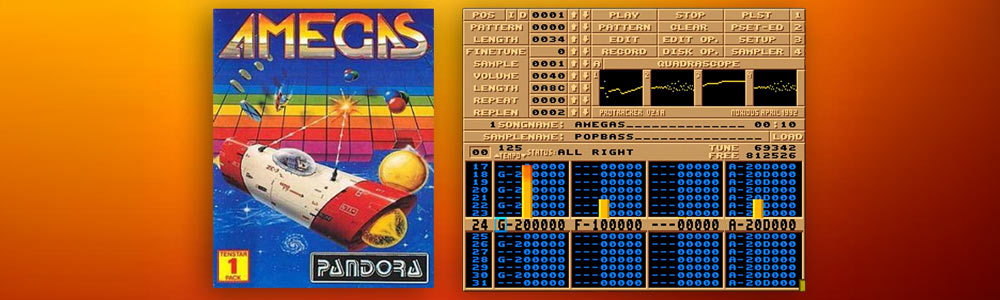
How a German game composer accidentally invented an entire music format
- Software: Ultimate Soundtracker
- Author: Karsten "Obi" Obarski
- Genres: Chiptune, electronica, ambient, jazz, video game music
- Year: 1987
- Platform: Commodore Amiga 1000
- First known module: Music for the game Amegas
Before the MOD Format Existed
In the mid-1980s, making music on a home computer meant one of two things: writing raw code to drive the machine's sound chip directly, which required real programming skill, or working in MIDI, which needed external hardware most hobbyists couldn't afford. There was no simple, visual way for a musician without a programming background to compose digital music on a home computer.
That changed with the release of the Commodore Amiga in 1985. Its "Paula" sound chip could play four channels of digitized 8-bit samples at once, entirely in hardware, with barely any help needed from the main processor — a huge leap over what most machines of the era could do.
Karsten Obarski and the Ultimate Soundtracker

The person who unlocked that potential for ordinary users was Karsten Obarski, a German developer and composer working for the software company EAS. In the summer of 1987, at just 22 years old, Obarski wrote his very first completed program: a piece of software he called the Ultimate Soundtracker.
The idea was simple but transformative. Instead of hand-coding music note by note, Obarski's program displayed four vertically scrolling channels — labeled Melody, Accompaniment, Bass, and Percussion — that a musician could fill in directly, using the Amiga's sample-playback hardware to bring each channel to life. It was, in effect, the first music tracker ever built, and the file format it saved to would later become known simply as MOD, short for "module."
Obarski released Ultimate Soundtracker commercially through EAS at the end of 1987. It sold for 99 Deutsche Marks and, ironically, was not a commercial success — it reportedly crashed often on certain Amiga configurations. But the idea behind it was too good to disappear. Scene groups quickly copied, cracked, and improved on it, spawning descendants like NoiseTracker and later ProTracker, which spread the MOD format across the entire demoscene and tracker music community for decades to come.
The First Module: Music for "Amegas"
Before any of that snowballed, though, there was a very first file — the very first piece of music ever composed in the format Obarski invented. He wrote it for a colleague of his, using his own brand-new tool, as the soundtrack to a video game.
That game was Arkanoid-style breakout clone Amegas, developed by the German studio reLINE Software (credited in some releases under the name Pandora Software). Obarski composed the game's music directly in Ultimate Soundtracker, and both the game and the tool were released in the same year, 1987 — making the Amegas theme the very first tracker module in history.
That original module still survives and can be heard today, preserved by chiptune archivists and demoscene historians as a kind of founding artifact of an entire musical culture — the ancestor of everything from Amiga demo soundtracks to the chiptune scenes still active on platforms like SoundCloud and Bandcamp today.
An interesting fact turned up during research: a historical reference document on the format explicitly lists Amegas among the tracks composed by Karsten Obarski himself—alongside titles such as Crystal Hammer, Rallymaster, and Sarcophager—confirming that it is indeed one of his very first compositions created with the tool.
A Closer Look at the Technology Behind It
To really appreciate what Obarski pulled off, it helps to look at the hardware itself. Amiga audio was handled by a custom chip nicknamed Paula (officially the MOS 8364). Paula offered four independent channels, each capable of playing back an 8-bit PCM sample at rates of up to roughly 28 kHz. Two of those channels were hard-panned to the left speaker and two to the right, giving a fixed, no-frills kind of stereo — long before software could freely pan a channel anywhere across the stereo field. Each channel also had its own 6-bit volume control (64 steps) and its own playback frequency, and an external analog low-pass filter smoothed out the raw digital edge of the sound.
Ultimate Soundtracker mapped its four on-screen tracks — Melody, Accompaniment, Bass, and Percussion — directly onto these four hardware channels. That direct, one-to-one relationship is part of why the tool ran so efficiently: there was no complex mixing to compute in software, just four samples being streamed straight out of the chip.
The very first version of the format came with real constraints, though. A song could use no more than 15 samples/instruments in total — a limit that would only be lifted to 31 two years later, when Swedish programmers released NoiseTracker. The format also supported just two playback effects at this early stage, compared to the much richer effect sets that later trackers would introduce. Obarski's program shipped with a companion disk of ready-made instrument samples, called ST-01, which many early composers — very likely including Obarski himself for the Amegas score — drew on directly rather than recording everything from scratch.
Even tempo carried a quirky bit of technical history. Ultimate Soundtracker modules defaulted to 120 BPM, a value tied directly to the Amiga's custom chip clock of 716 kHz, working out to roughly 48 Hz. Some historians believe Obarski was actually aiming for 50 Hz — the PAL screen refresh rate — and simply made a small miscalculation that stuck as the format's default ever since.
None of this made Ultimate Soundtracker especially powerful on paper. But that was almost the point: by working within the hardware's real limits — four channels, 8-bit samples, a handful of instruments — Obarski made it possible for a musician with zero programming knowledge to compose real, sampled music on a home computer for the very first time.
Why It Mattered
What made Obarski's work significant wasn't just that it was first — it was that it made a completely new kind of composition accessible. Musicians without any programming background could suddenly build entire multi-channel songs out of real recorded sound, using nothing but a keyboard and a grid on screen. That shift — from "coding" music to "tracking" it — is the direct ancestor of the modern digital audio workstation, and the tracker interface itself lived on for decades in tools built by demoscene musicians long after the Amiga era ended.
Read More
- Wikipedia: Ultimate Soundtracker
- Wikipedia: MOD file format
- Wikipedia: Karsten Obarski
- Soundtracker origins: Where in the world is Karsten Obarski?
- Nameless Algorithm: A history of trackers
- Technical reference: the Ultimate Soundtracker file format
- Listen: the original Amegas module on YouTube