How AI can help develop soundtrackers for vintage machines
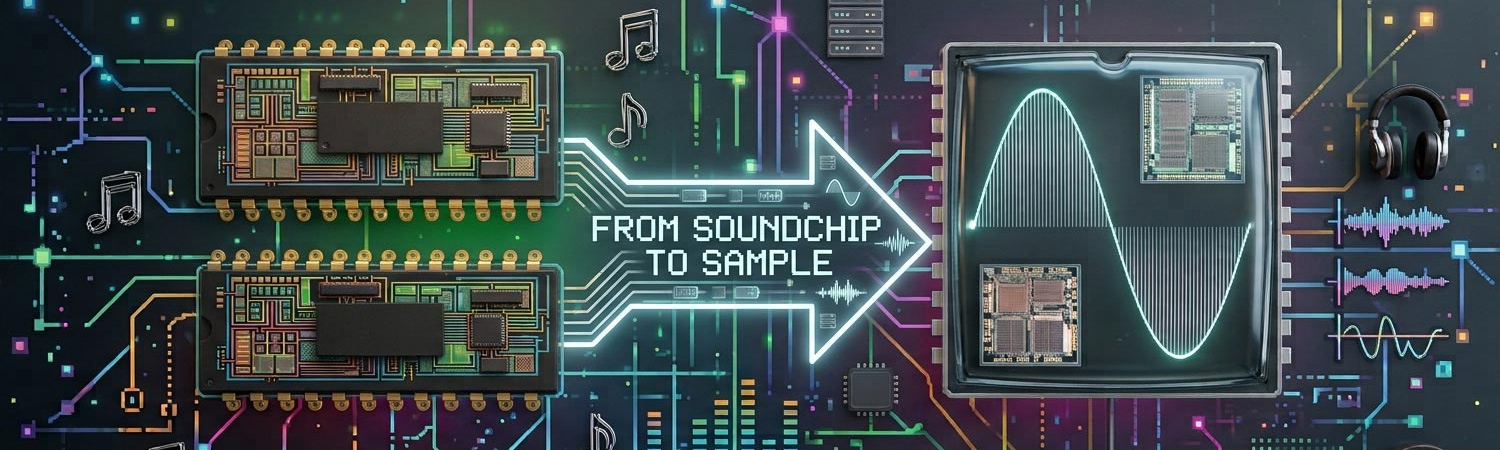
From the Commodore 64's SID chip to the Atari ST's Yamaha YM2149 and the Amstrad CPC's AY-3-8912, 8-bit and 16-bit sound chips still fascinate composers and coders decades later. Artificial intelligence is quietly becoming a useful companion in this scene — not to replace the craft, but to speed up the tedious parts and open new creative doors.
1. Understanding the Hardware Faster
Writing a tracker for a chip like the MOS 6581/8580 SID or the General Instrument AY-3-8912 requires digesting old datasheets, forum threads, and disassembled source code. Large language models can summarize these dense technical documents, explain register layouts in plain English, and even generate annotated code skeletons for reading or writing to the sound registers. This is especially helpful for newcomers exploring resources like CSDb (the Commodore 64 Scene Database) or Atari-Forum.com, where a lot of knowledge is scattered across decades of posts.
2. Assisting With Assembly and C Code
Most trackers for these machines are still written in 6502/6510, Motorola 68000, or Z80 assembly, sometimes with a thin C layer. AI coding assistants are good at:
- Generating boilerplate players and interrupt routines
- Explaining cycle-timing constraints for raster-accurate playback
- Porting existing open routines between platforms (e.g. adapting a Z80 player concept for the Amstrad CPC's AY chip to a similar approach on the ZX Spectrum)
- Spotting bugs in packed pattern-data parsers, which are notoriously fiddly on these platforms
Projects hosted on GitHub's chiptune topic page show a growing number of trackers and players where AI-assisted commits and code review are becoming part of the normal workflow, alongside traditional cross-assemblers like vasm.
3. Composition Assistance, Not Composition Replacement
Chiptune composition on real hardware is a constrained art form — three SID voices, three AY channels, or the Atari ST's own limitations force clever tricks like arpeggios and pulse-width modulation to simulate richer sounds. AI tools can:
- Suggest chord progressions or basslines that fit the genre
- Analyze existing modules from archives like the High Voltage SID Collection to help a composer understand common patterns in classic C64 music
- Generate MIDI sketches that a musician then manually adapts into tracker patterns, since final translation to hardware-accurate SID or AY commands still benefits from a human ear
The goal isn't to let AI "write the song," but to remove some of the blank-page friction so the composer can focus on the parts that make these engines sing.
4. Smarter Sample and Data Compression
Memory is brutally limited on these machines — 64KB on the C64, up to 4MB (but often much less usable) on an Atari ST, and 64/128KB on the Amstrad CPC. AI-assisted tools can help evaluate which compression scheme (like the popular Exomizer or various cruncher tools on CSDb) best trades off decompression speed against playback size for a given track, based on pattern repetition analysis.
5. Documentation and Onboarding
Perhaps the most immediately practical use is documentation. AI chat tools can turn a cryptic old
.txt readme from a 1990s tracker into a clear, modern tutorial, or answer beginner
questions about file formats like .sid, .ym, or .ay in
real time — lowering the barrier for new developers exploring these platforms via communities such
as Pouet.net for demoscene culture.
6. Technically, How Do You Work With AI on This?
In practice, building a soundtracker with AI assistance looks less like "type a prompt, get a finished tracker" and more like an iterative pair-programming session. Here's roughly how it goes:
a) Chat-based assistance for research and code snippets
The simplest way in is a conversational AI assistant (in a browser or app). You paste in a fragment of a datasheet, an old disassembly listing, or a snippet of 6502/Z80/68000 assembly, and ask it to explain what a routine does, or to draft a new routine following the same conventions. This works well for isolated problems: "explain how this SID envelope table is being read," or "write a Z80 routine that copies AY register values from a pattern buffer on each frame interrupt." You review, test on real hardware or in an emulator, and iterate.
b) Agentic coding tools for whole-project work
For larger, multi-file projects — like a full tracker with a UI, a file format, and a player
routine — tools such as Claude Code (or similar agentic coding assistants) can work
directly inside your project folder: reading your existing source tree, running your
cross-assembler (e.g. vasm, ca65, or sjasmplus) or emulator
from the command line, and iterating based on the actual build output or test results, rather than
just producing a code block you copy-paste. This is closer to having a junior collaborator who can
run make, read the error, and fix it.
c) Feeding it the right context
AI models don't inherently know the register map of the AY-3-8912 or the exact timing budget of a C64 raster interrupt down to the cycle. Results improve a lot when you supply:
- The relevant datasheet excerpt or register table
- An example of working, idiomatic code in the target dialect of assembly
- Your target constraints (memory budget, CPU cycles per frame, file format spec)
This is the same "give the model good context" principle behind prompt engineering guides: be specific, provide examples, and let the model reason step by step before writing code.
d) The verification loop still belongs to you
Because timing and hardware quirks on these machines are unforgiving, the actual verification — does it play in tune on real hardware, does the interrupt routine fit its cycle budget, does the compressor actually save space — still has to happen in an emulator (like VICE for the C64 or Hatari for the Atari ST) or on original hardware. AI accelerates the drafting and debugging cycle; it doesn't replace testing.
A Human Craft, Assisted
Vintage soundchip programming remains a deeply human, deeply constrained art. AI won't replace the ear that knows exactly how to fake a fourth SID voice, or the patience needed to hand-optimize a raster routine. But as a research assistant, code reviewer, and creative sounding board, it's already helping a new generation keep the Commodore 64, Atari ST, and Amstrad CPC singing.
Further Reading
- GPT-64. Galway Programmable Tracker 64 is a very interesting project which is to build a native Commodore 64 music tracker with AI on C64
- MOS Technology SID — Wikipedia overview of the C64 sound chip
- Demoscene — Wikipedia, on the culture behind trackers and chiptunes
- The Mod Archive — a huge library of tracker music modules
- chipmusic.org — community forum for chiptune and tracker musicians
- Modland — archive of tracker/chiptune formats across many platforms
- Claude Code documentation — agentic coding in your own project