Explore the museum
Explore the extensive and ever-growing collection of trackers for each platform, featuring detailed information.
Explore the extensive and ever-growing collection of trackers for each platform, featuring detailed information.
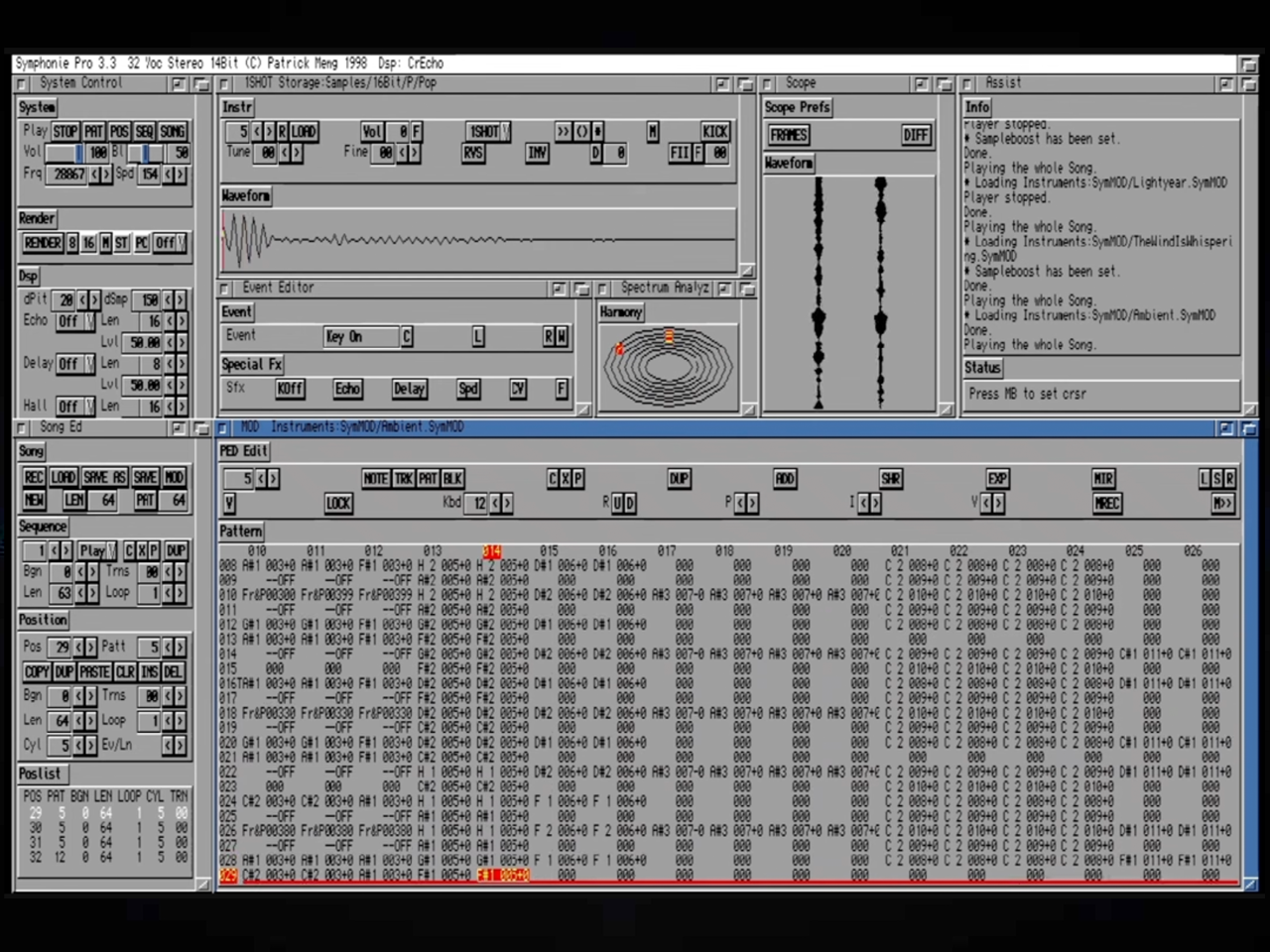
Symphonie Pro is an advanced music tracker and digital audio composition system developed by Patrick Meng for the Commodore Amiga. First released as commercial software, it became one of the most technically ambitious tracker programs of the Amiga era, pushing far beyond the traditional four-channel limitations of the Paula audio chipset. The final version, Symphonie Pro 3.3d, was later released as freeware together with its source code.
Unlike conventional Amiga trackers that relied primarily on Paula's four hardware channels, Symphonie Pro performed extensive software-based audio mixing and DSP processing. Its architecture allowed up to 256 audio channels, making it possible to create arrangements containing a very large number of simultaneous samples and voices. This capability was particularly suited to accelerated Amigas with faster Motorola 68020/030/040/060 processors.
Symphonie Pro supports 16-bit samples and high-resolution internal processing. Its audio engine offers high-resolution frequency and volume control, together with sophisticated interpolation and mixing techniques. The software could work with sample rates extending into the hundreds of kilohertz, with documentation advertising support up to 500 kHz mixing rates and three-phase oversampling.
The tracker also includes extensive real-time sound processing. Individual channels can use resonant filtering, while the DSP system provides effects such as echo, delay and flanging. Additional DSP effects could be implemented through its plugin architecture, making Symphonie Pro unusually extensible for an Amiga tracker.
Symphonie Pro is not a synthesizer in the traditional sense; its sound generation is fundamentally sample-based. However, its sophisticated sample-processing capabilities allowed musicians to transform samples extensively. Processing included resonant and conventional filters, waveshaping, sample mixing and